By Lisa Beck, CRITICS PAGEJUNE 2018, Read the full article →
Agnes Pelton: The Familiar Sublime
Standing in front of Agnes Pelton’s Sea Change (1931) at the Whitney Museum recently, I heard another viewer looking at the same work say, “Now, that’s weird.” It struck me as an odd remark, because this quiet little painting seemed an unlikely work to provoke such a comment. And yet, on further inspection, there issomething strange about Sea Change.
At first glance it seems to be a simple sky/cloudscape, but then the dark curve passing across the upper edge—a stylized wave shape—becomes apparent, as does the swelling form at the lower edge. The green and white mass in the center has an inverted teardrop shaped bubble emerging from it, seemingly glowing from within. Are these cloud-like forms part of the sky seen through the arch of a breaking wave, or some kind of life form emerging from the foam? Is the wave dangerous? What will happen when it comes crashing down? Something is being revealed here, but what? As one looks longer, more questions are raised than answered. The work is executed in an un-dramatic style, with inconspicuous brushwork and delicately modeled, subtle colors, but with an inner energy, and an intent beyond mere description.
In one of my favorite of her works, Sand Storm (1932), the painting’s edge is bordered by a looping line, indicating the storm’s clouds of dust, that part to reveal a glowing, blue sun/flower/mandala and a rainbow, which provide the only colors that stand apart from the dusty greens of the storm. It emits a kind of crepuscular glow, and the elements of the painting work together as a simultaneous, multiphasic evocation of order and chaos, sun and shadow, life and death.
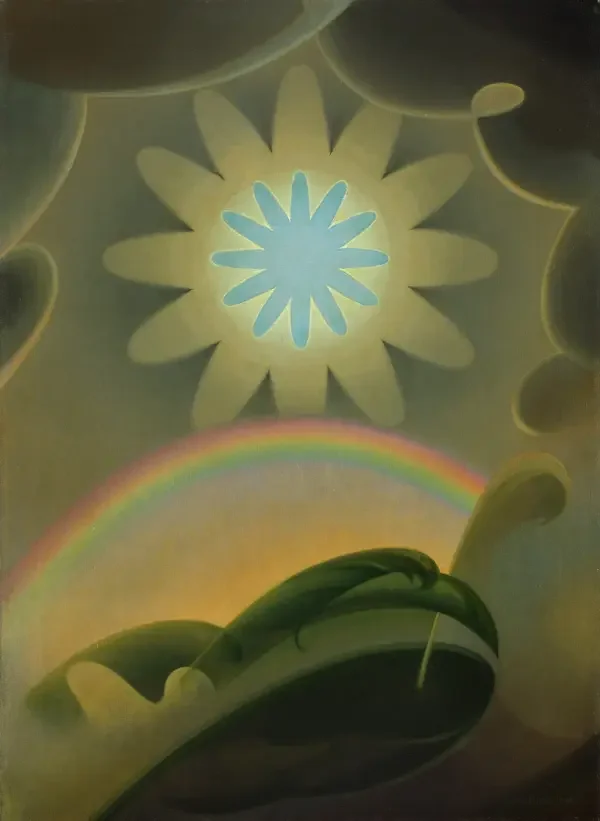
BeinAgnes Pelton, Sand Storm, 1932. Oil on canvas, 30 1/4 x 22 inches. Crystal Bridges Museum of American Art, Bentonville, Arkansas. Photo: Edward C. Robinson III.g by Agnes Pelton, 1926.