By Samantha Friedman, Mar 20, 2024. Read the full article →
Made in a studio inside a windmill, Pelton’s transcendent painting transforms esoteric ideas into orbs of color.
The artist Agnes Pelton, when she is known at all, is known as a “desert transcendentalist.” After earlier visits to Taos, New Mexico, and Pasadena, California, she moved to Cathedral City, just outside of Palm Springs, in 1932. The physical features and esoteric energies of the southwestern landscape perfectly suited her spiritual beliefs, which included Theosophy and its offshoot, Agni Yoga. In the desert, she ultimately found the
“abstract beauty of the inner vision, which would be kindled by the inspiration of these rare and solitary places.”
Yet Pelton was born in Germany, raised in Brooklyn, and spent the early part of her career in New York, first in a downtown Manhattan studio, and then in a more unusual space on Long Island. Starting in 1921, she lived and worked in the Hayground Windmill, in Water Mill, which she considered “a mystical house.”
It was here that she pushed her practice from the Symbolist-inflected figuration of what she christened her “Imaginative Paintings” of the 1910s—examples of which were included in the 1913 Armory Show—toward the elemental form of her work in the 1920s and beyond. “Finally, during the winter of 1926, in the quiet of my windmill studio, I began to work on some pure abstractions,” she wrote.
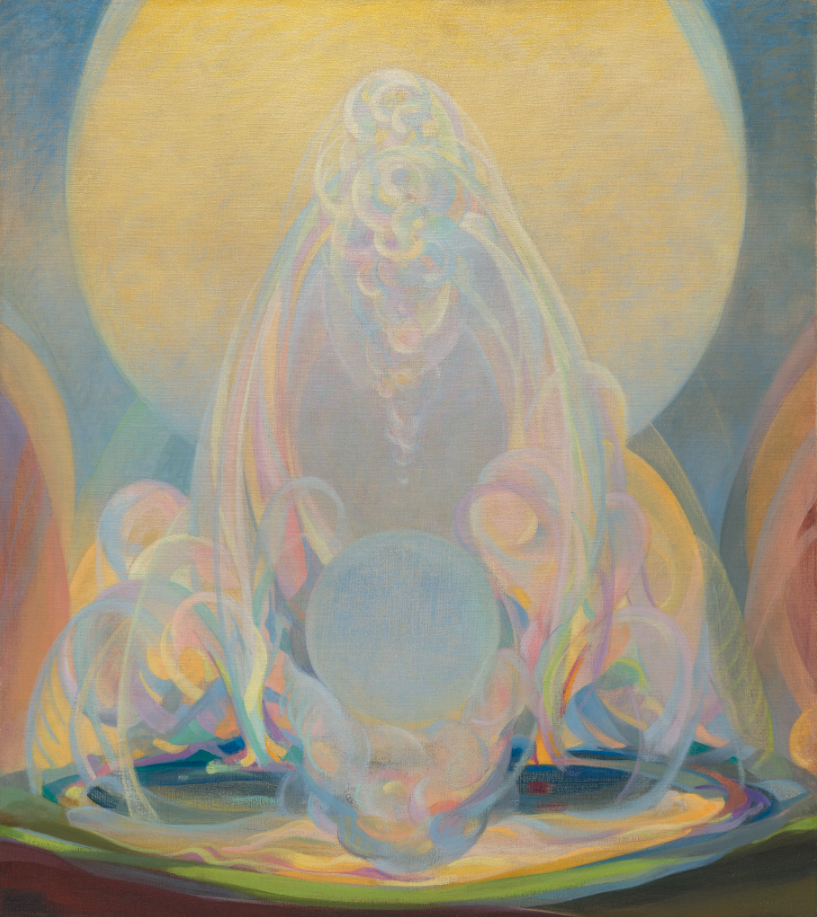
Agnes Pelton, Messengers, 1932. Phoenix Art Museum.