
The Life of Agnes Pelton
An Authentic Life Guided by Inner Vision
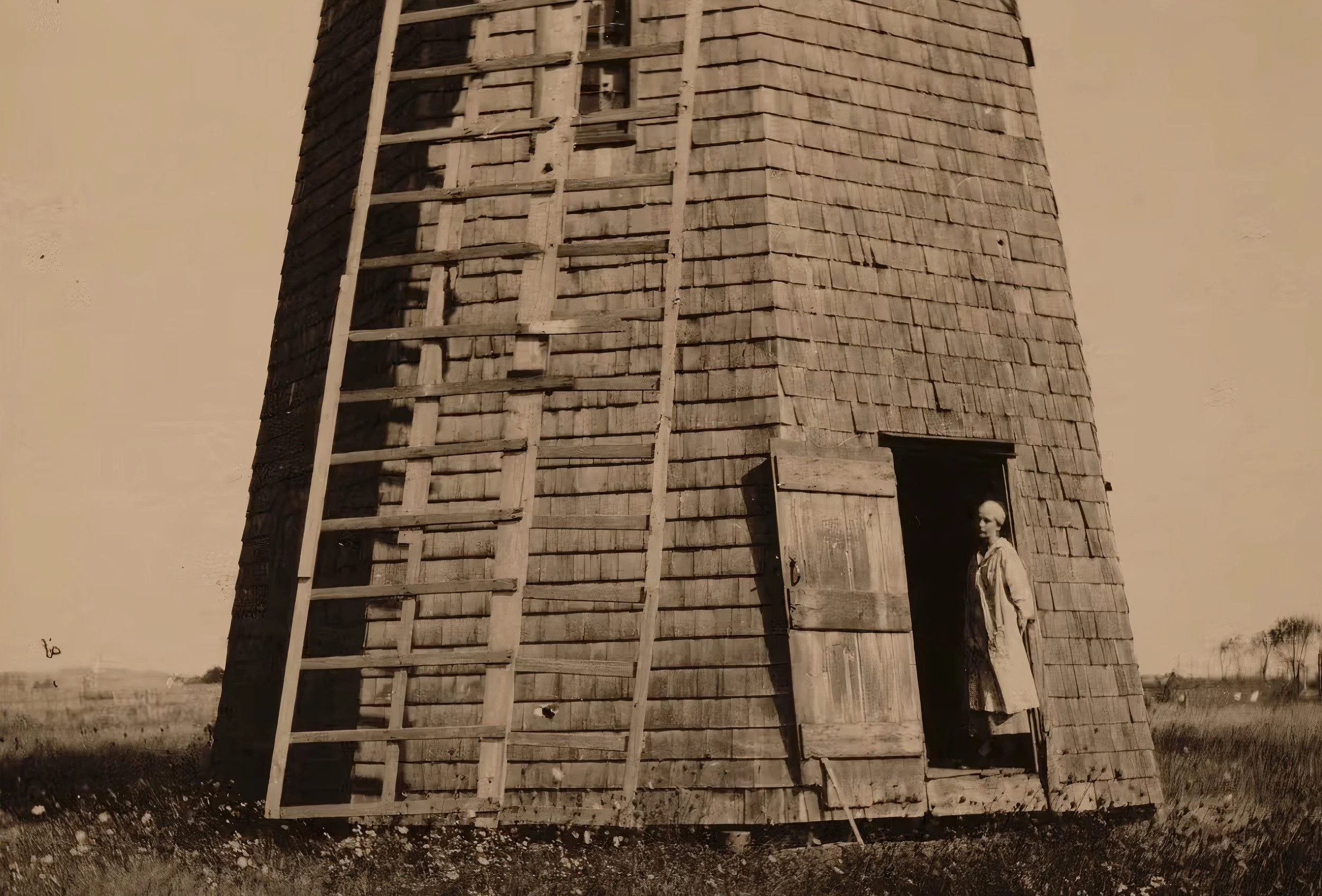
AI-generated reenactment of Agnes Pelton standing outside her windmill studio, 1921. Based on an original photograph. After her mother’s death in 1920, Pelton sought solitude at the Hayground Windmill on Long Island.
Agnes Pelton (1881–1961) was a visionary painter who sought the meeting point between the visible and the unseen. Painting, for Agnes was a form of communion.
Her paintings emerged from a meditative discipline, a practice of stillness through which she transformed contemplation into form.
Art was both revelation and refuge, a language through which she reached toward what she called “a higher consciousness within the universe.” Born in Germany to American parents, Pelton spent her early years in Europe. After her father’s death from a morphine overdose when she was nine, Pelton and her widowed mother returned from Europe to Brooklyn, where they lived with her maternal grandmother. To support the family, Florence Pelton taught piano classes from their home. Life was modest but steady, shaped by quiet endurance and her mother’s unwavering resilience, a formative environment that nurtured young Agnes’s inward nature and early imagination.
She studied art in both the United States and Europe, developing a foundation that bridged tradition and imagination. Over time, her art evolved through three distinct phases: the early “Imaginative Paintings,” her depictions of the people and terrain of the American Southwest, and finally, the luminous abstractions that expressed her deepest spiritual beliefs. That search for transcendence unfolded not only in her paintings, but in the life she quietly shaped around them.

ExploreAgnes Pelton Family Tree →
Trace Agnes Pelton’s lineage and explore the family roots and cultural background that informed her beginnings.
Agnes as a Child, c. 1887, Stuttgart, Württemberg, Germany. Scanned March 30, 2021 by Nyna Dolby. From the Carolyn Tiltno Cunningham Family Collection.
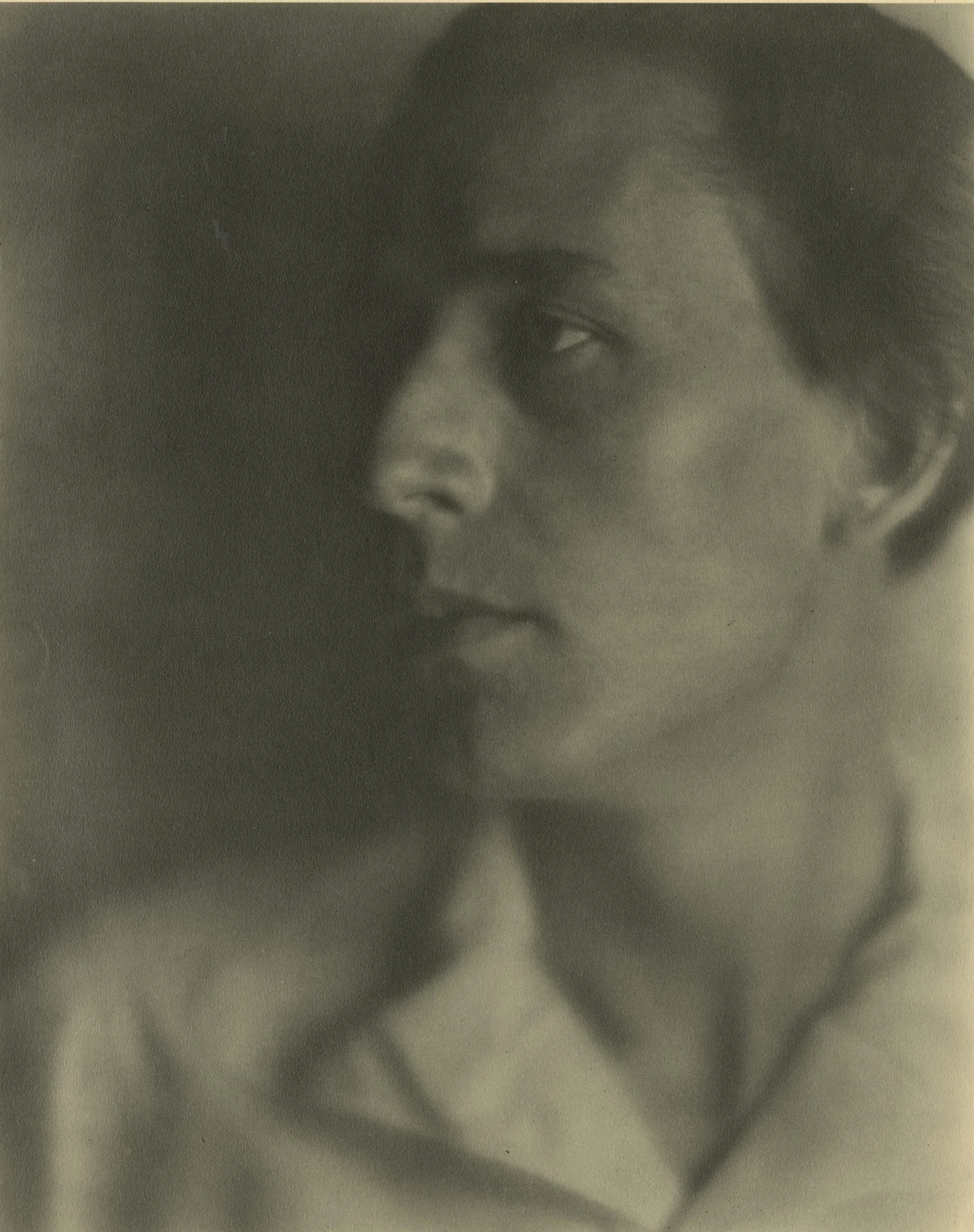
An early portrait of Agnes Pelton. By Photographer Alice Boughton. 20th Century
EDUCATION
Pelton drew from both classical training and New York City’s growing energy of experimentation.
Agnes studied at the Pratt Institute in Brooklyn, graduating in 1900 alongside fellow modernist Max Weber. During this time, she worked closely with Arthur Wesley Dow, whose teaching blended Japanese aesthetics with the modernist harmony of light, form, and imagination.
Dow’s influence was central to Pelton’s development of abstractions grounded in spiritual values, and his teachings also shaped artists such as Georgia O’Keeffe. He encouraged his students to look beyond realism and to see structure, color, and space as expressions of inner life.
Pelton studied in Italy in 1910 and 1911, taking life drawing lessons and studying Italian painters at the British Academy in Rome. She also studied with Hamilton Easter Field, another of her Pratt instructors, and took summer classes with William Langson Lathrop. These experiences refined her understanding of composition, deepened her sensitivity to tone and light, and strengthened her belief that art could express both emotion and spirit.
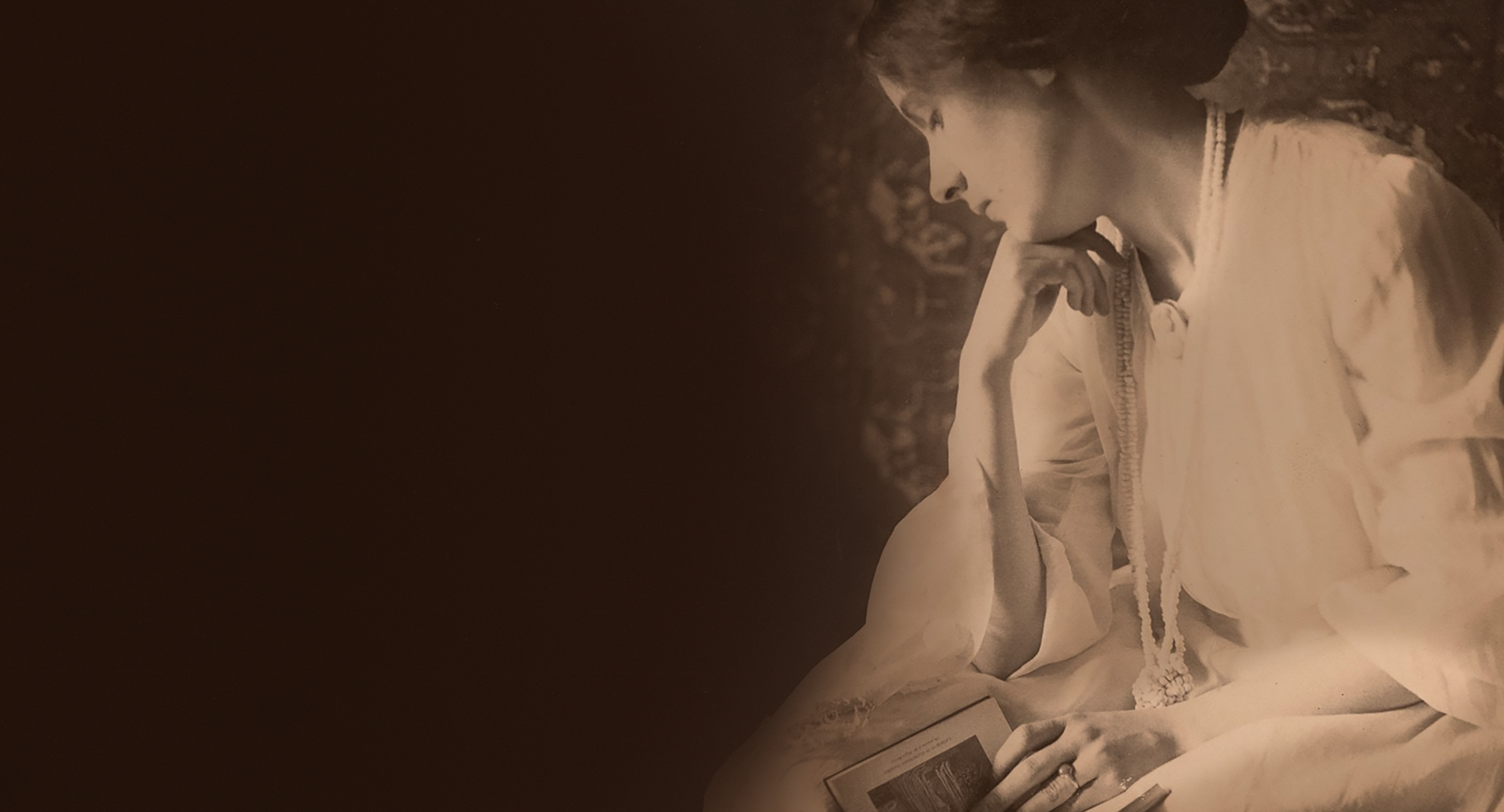
Friendship in Focus:
Agnes Pelton & Alice Boughton
As a trusted friend and fellow artist, Alice Boughton documented Pelton at the threshold of her creative awakening.
In the mid-1910s, Agnes developed a creative and personal connection with photographer Alice Boughton, resulting in several photographic sessions that captured Pelton at pivotal moments in her artistic life and career. Although the exact number of sessions is uncertain, archival prints indicate multiple sittings over a span of a decade or more. This visual collaboration offers a rare and intimate glimpse into the formation of Pelton’s artistic identity, preserved through Boughton’s lens.
Alice Boughton played a role in establishing photography as a fine art in the early twentieth century. Born in Brooklyn, she studied painting in Paris and at Pratt Institute, where she met her partner Ida Haskell and her mentor Gertrude Käsebier. Boughton became known for her pictorialist portraits, often of women and children as well as allegorical studies of the female form. In 1890, she opened a New York studio that she maintained for four decades. Her work was widely exhibited and published, including in Camera Work, and she was elected a fellow of the Photo-Secession in 1906. Boughton’s photographs, including portraits of figures such as Henry James and W. B. Yeats, are now held in major museum collections, reflecting a career defined by artistic sensitivity .
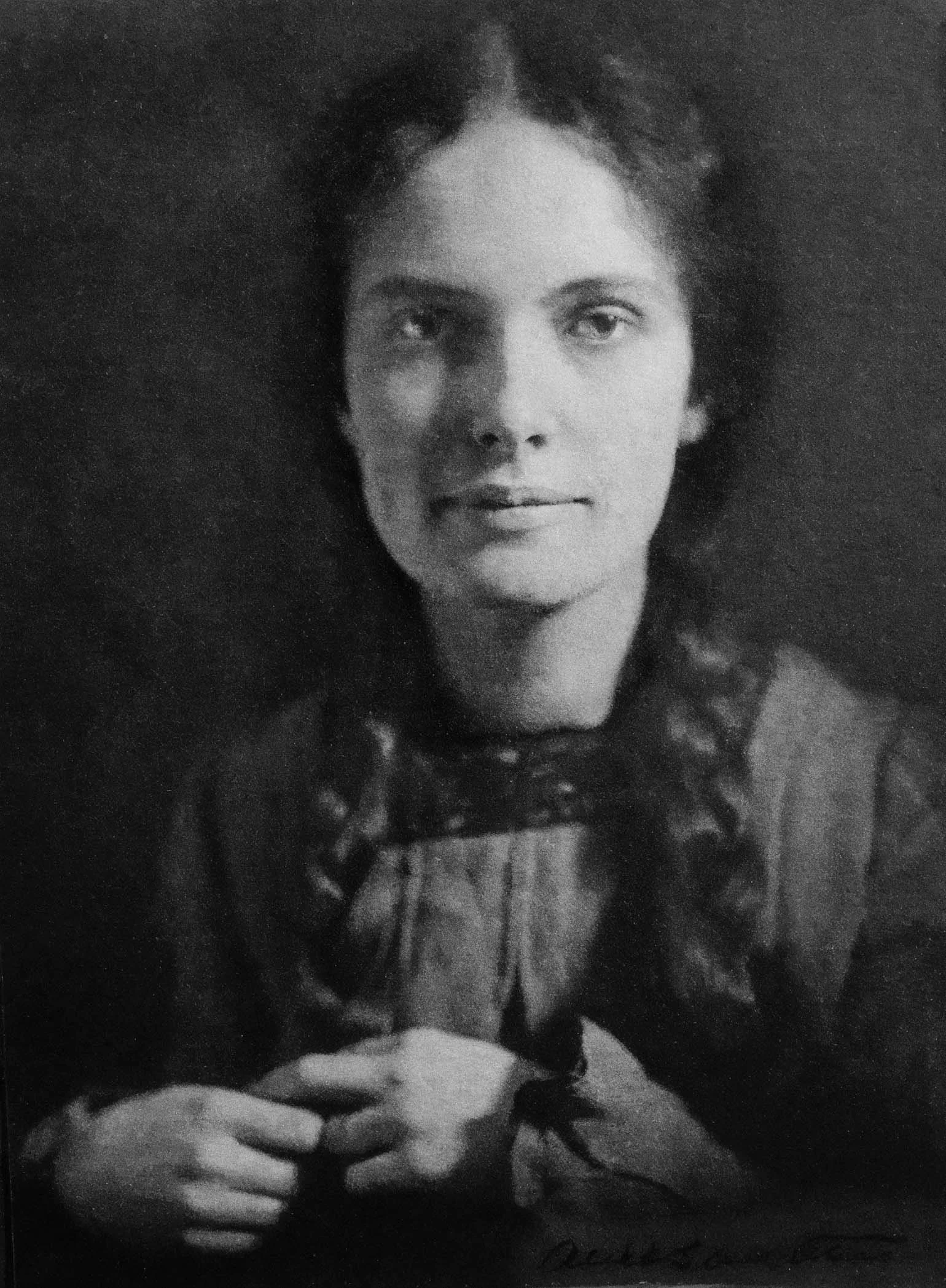
Photo of Agnes Pelton by Alice Boughton, circa 1901. Photo Curtesy of Nyna Dolby, restored by Peter Paladino, Agnes Pelton Society
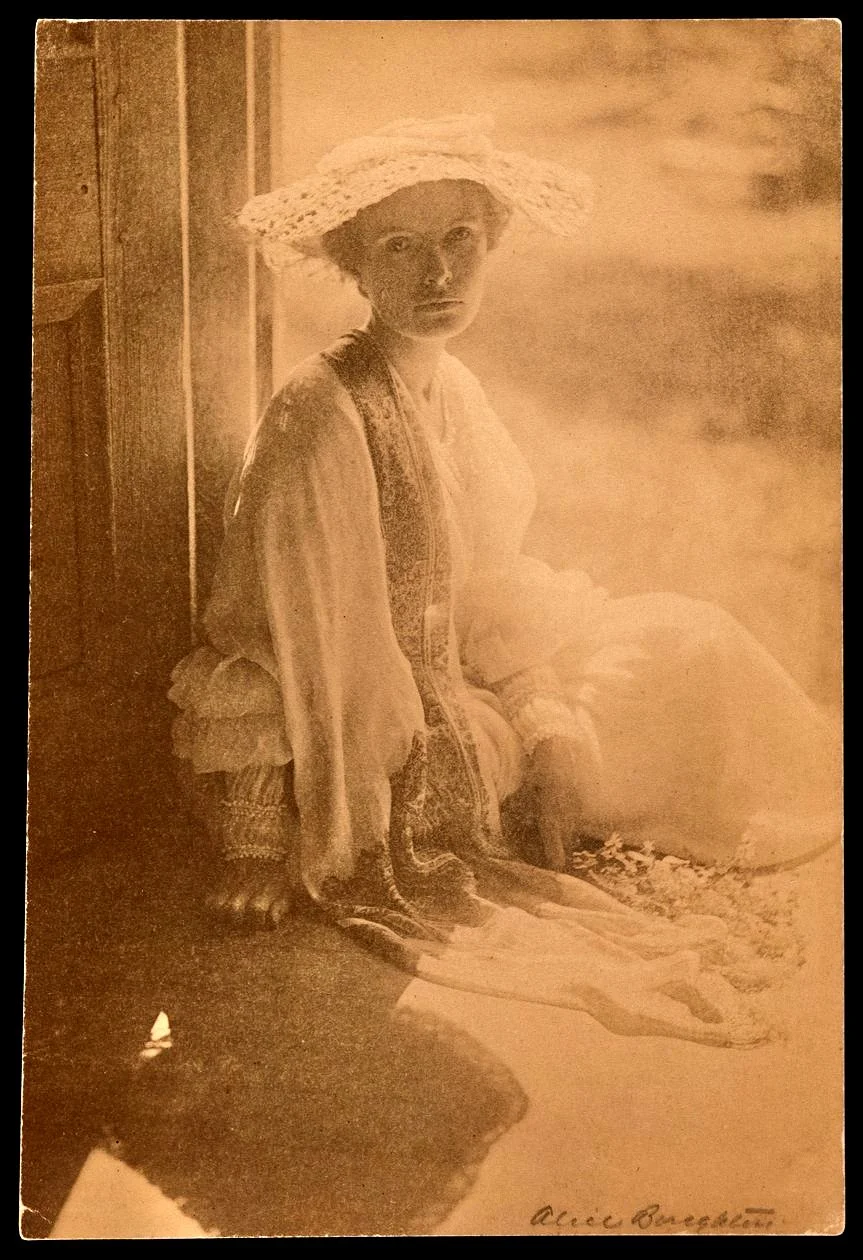
Photo of Agnes Pelton by Alice Boughton, date unknown. Private Collection. Courtesy of Nyna Dolby.
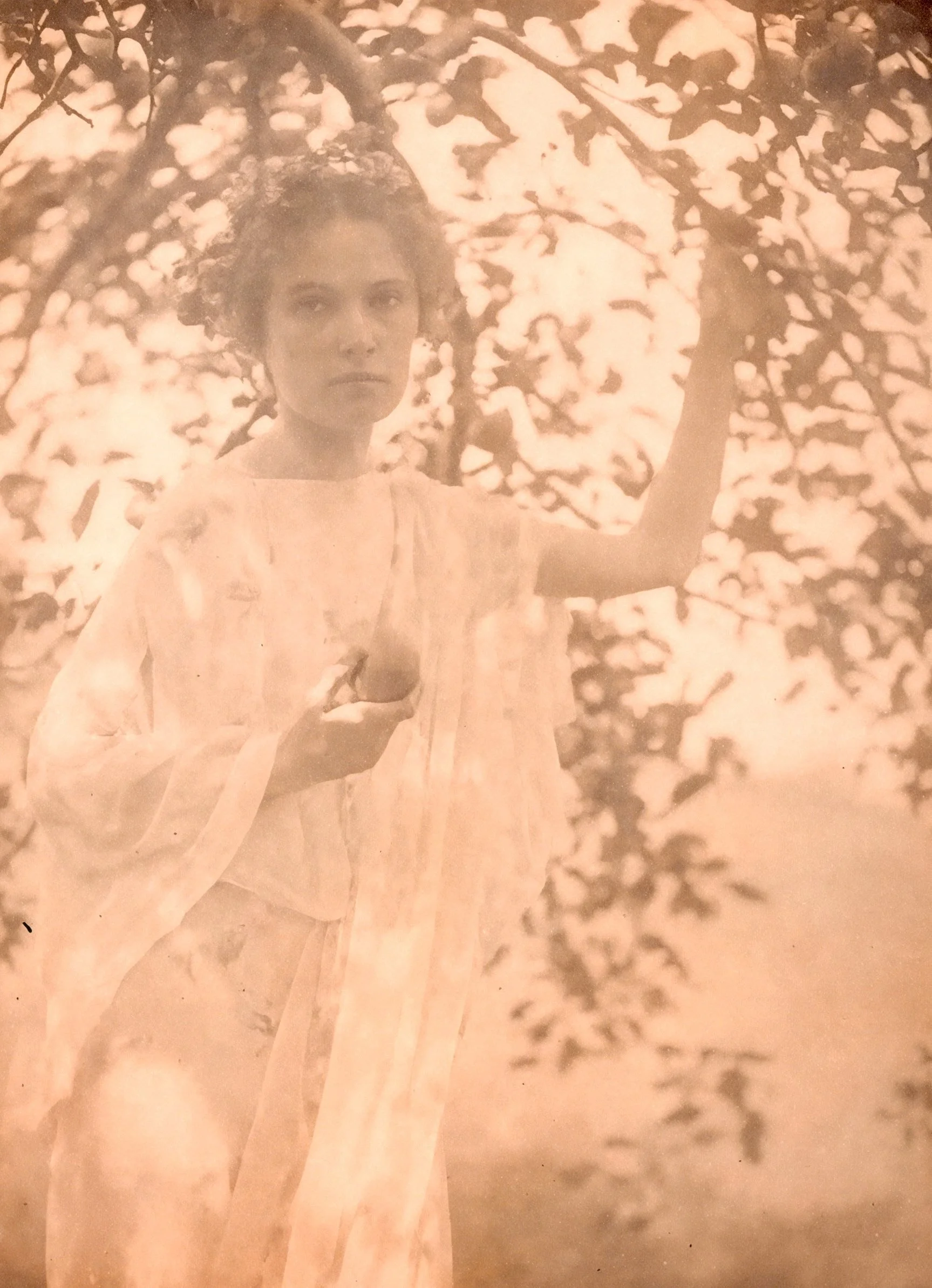
Photo of Agnes Pelton by Alice Boughton, 1909. Courtesy of Nyna Dolby.
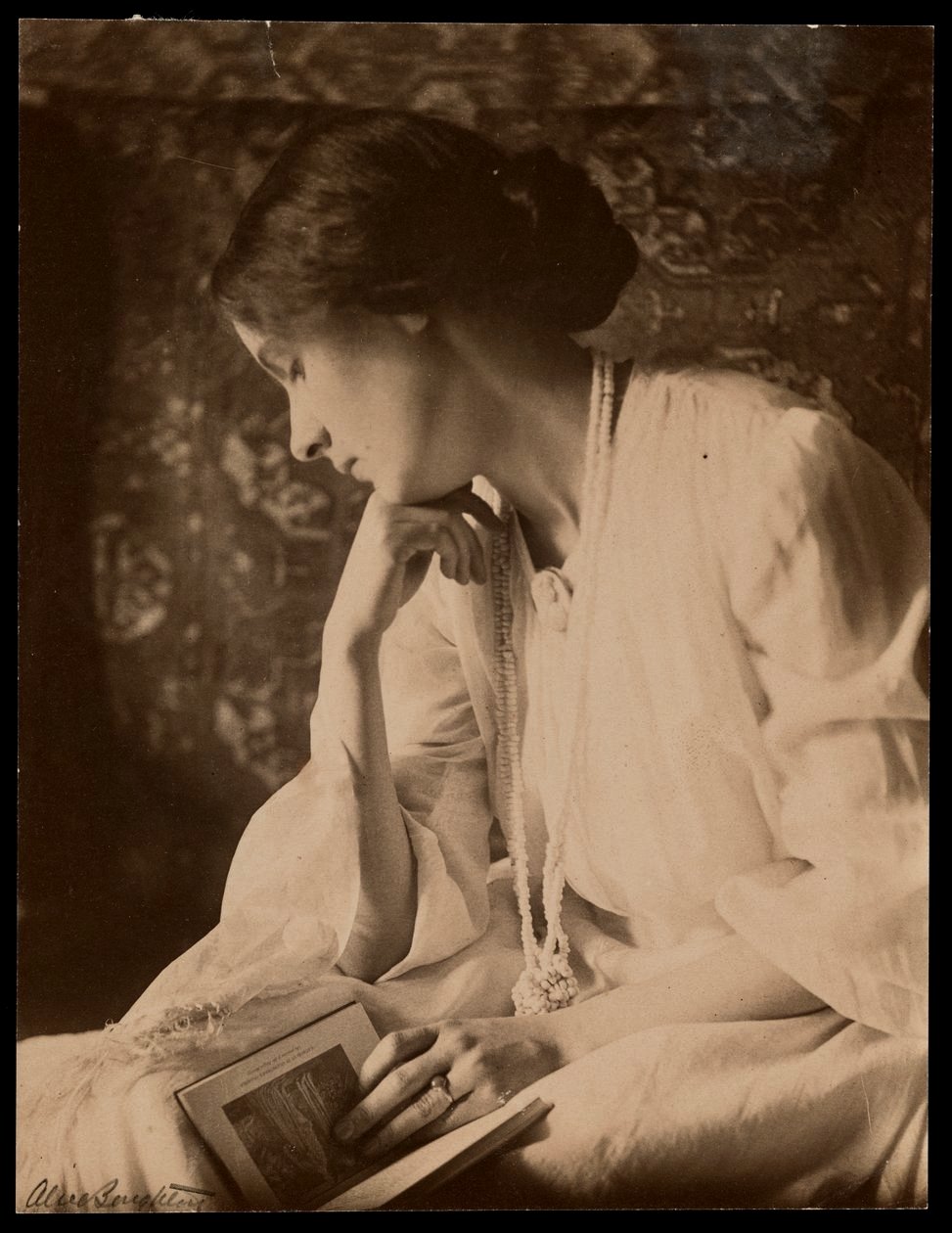
Photo of Agnes Pelton by Alice Boughton, date unknown. Courtesy of Nyna Dolby.
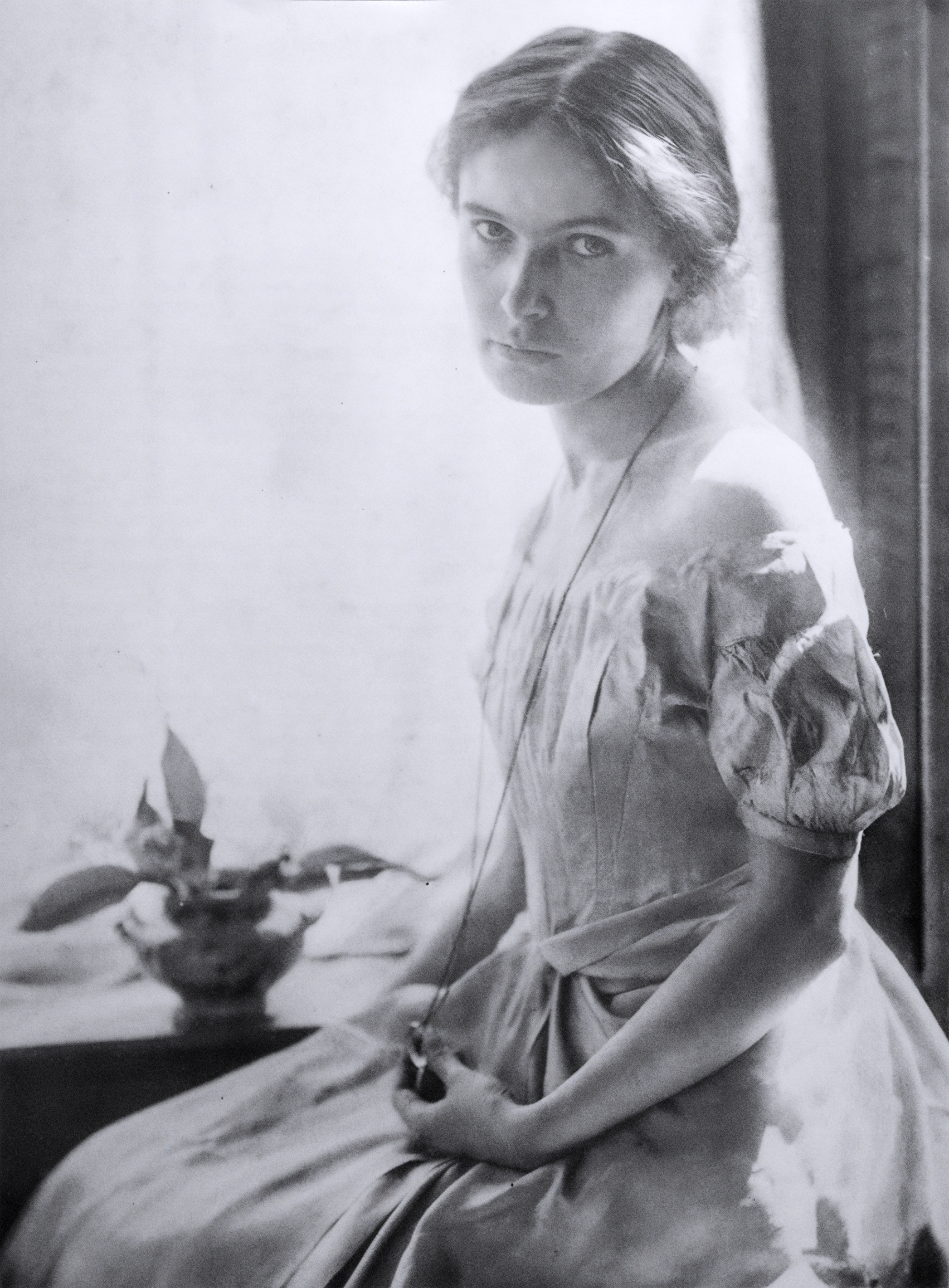
Photo of Agnes Pelton by Alice Boughton, date unknown. Carolyn Tiltno Cunningham Family Collection. Courtesy of Nyna Dolby.
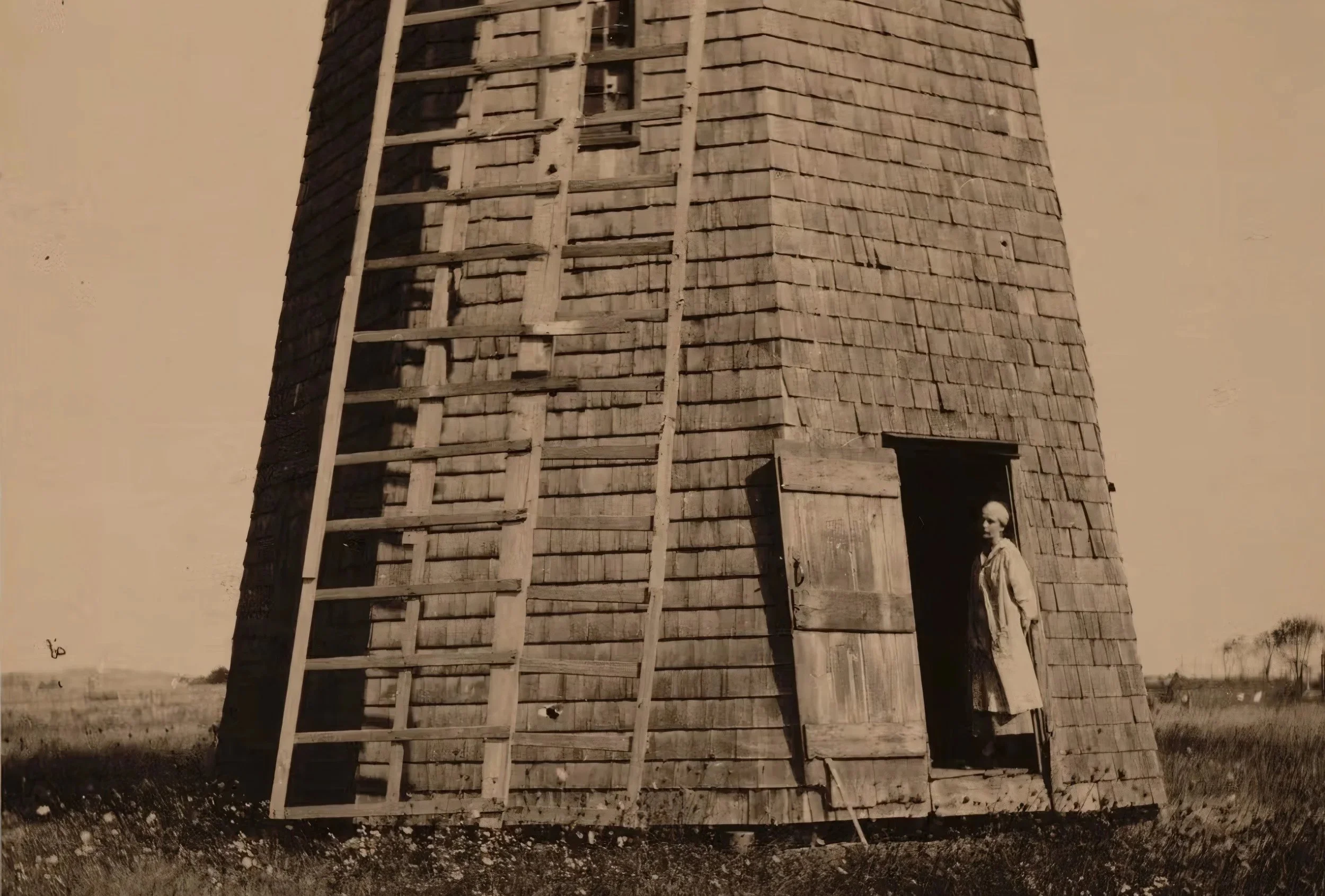
Agnes Pelton standing in the doorway of her home and studio at Hayground Windmill (built 1809), Water Mill, Long Island, circa 1921. Agnes Pelton papers, 1885-1989. Archives of American Art, Smithsonian Institution
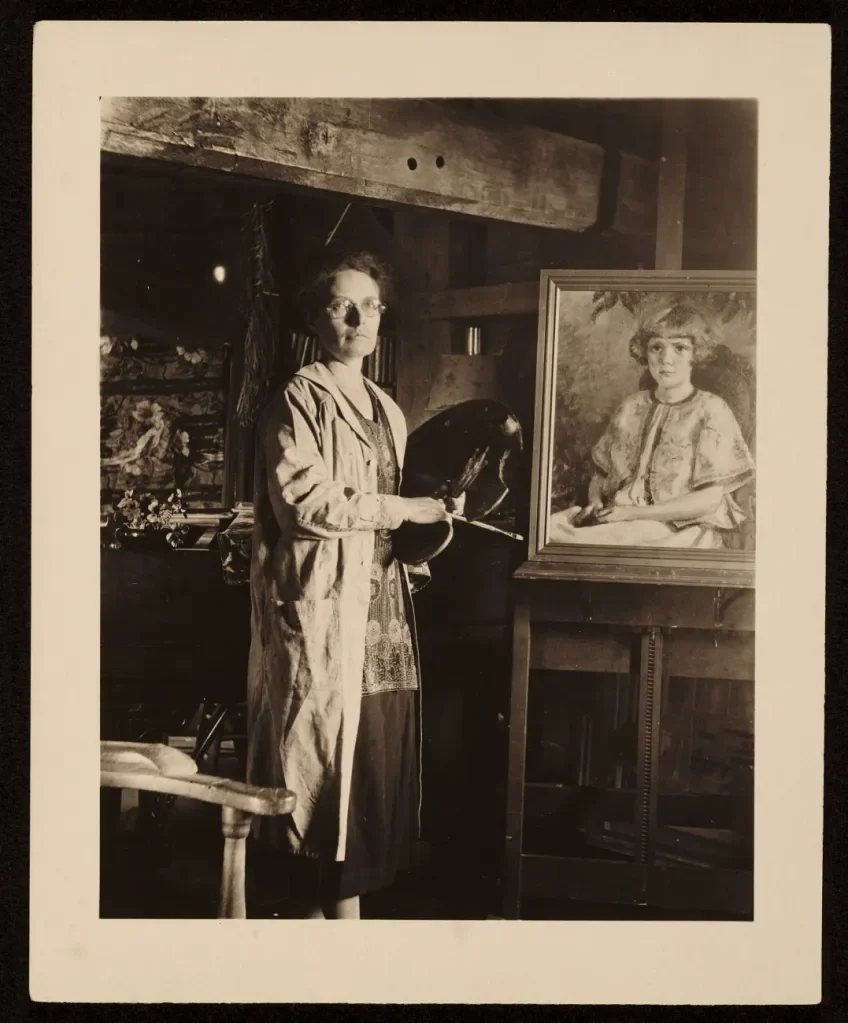
Agnes Pelton in her windmill studio, Agnes Pelton papers, 1885-1989. Archives of American Art, Smithsonian Institution
EARLY CAREER INFLUENCES
The 1913 Armory Show and the Foundations of American Modernism
Pelton’s work was exhibited in Ogunquit, Maine, at Hamilton Easter Field’s studio in 1912. Based on her work shown there, Walt Kuhn invited her to participate in the 1913 Armory Show, where two of her paintings, Stone Age and Vine Wood, were exhibited.
The works she called her “Imaginative Paintings,” influenced by Arthur B. Davies, explored the effects of natural light and the inner atmosphere of landscape. She created these poetic, light-filled canvases between 1911 and 1917. Her participation in the 1913 Armory Show placed her among the early voices of modernism, grounding her later spiritual vision in the discipline of craft and the evolving language of abstraction. The Armory Show proved to be a pivotal starting point for her creative path, there she formed a lifelong friendship with Mabel Doge who would later invite her out to the desert.
After her mother’s death in 1920, Pelton sought solitude at the Hayground Windmill on Long Island. In that quiet refuge, she turned inward, finding in isolation a path toward spiritual clarity. The desert would call to her a decade later.
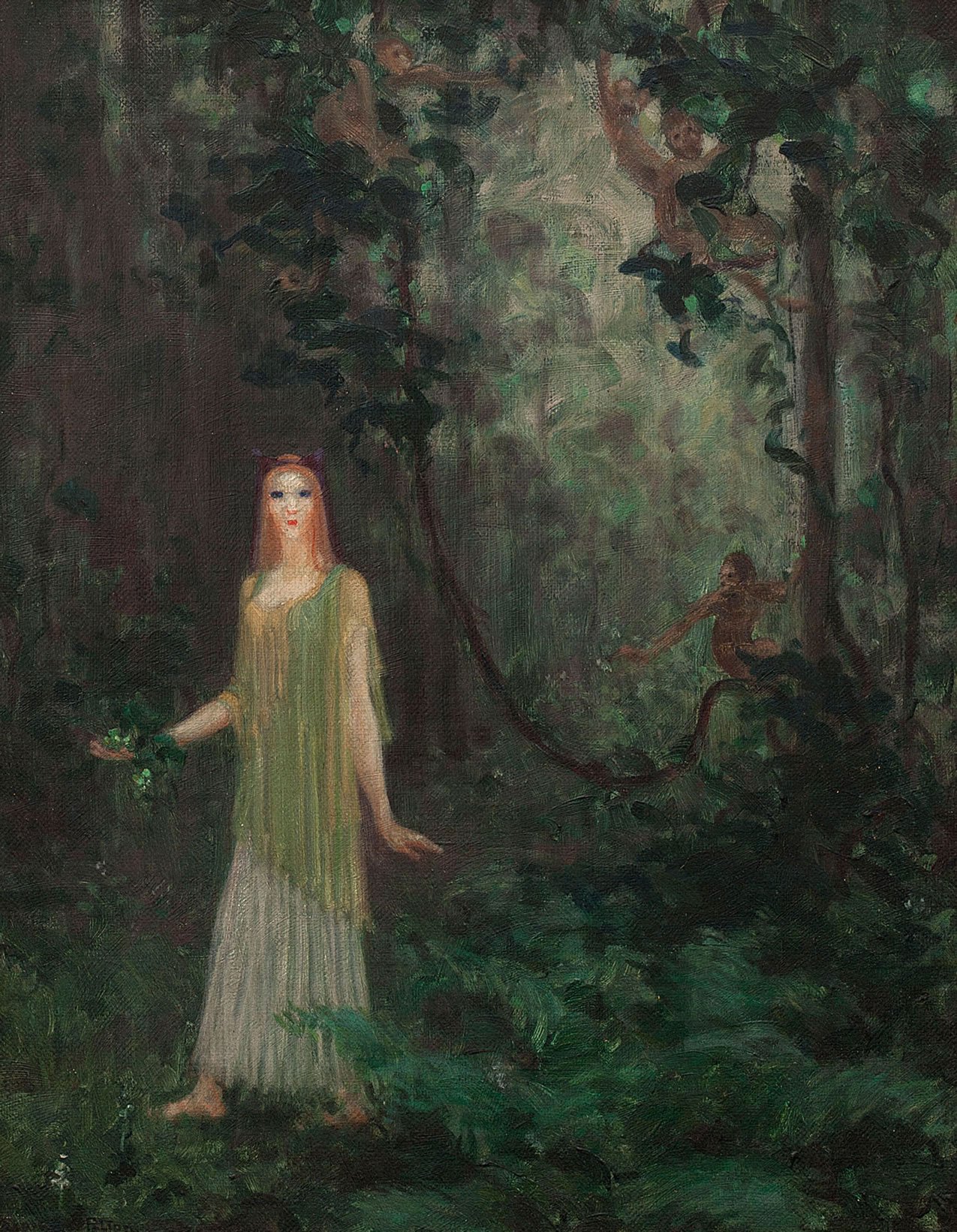
At the 1913 Armory Show, Pelton exhibited Vine Wood and Stone Age. In Vine Wood, she shaped a dreamlike world of layered greens where a lone figure blends into the foliage as monkeys move above—a vision of calm and unease where self and nature become one. This material is in the public domain in the United States because it was published or registered with the U.S. Copyright Office before January 1, 1930.

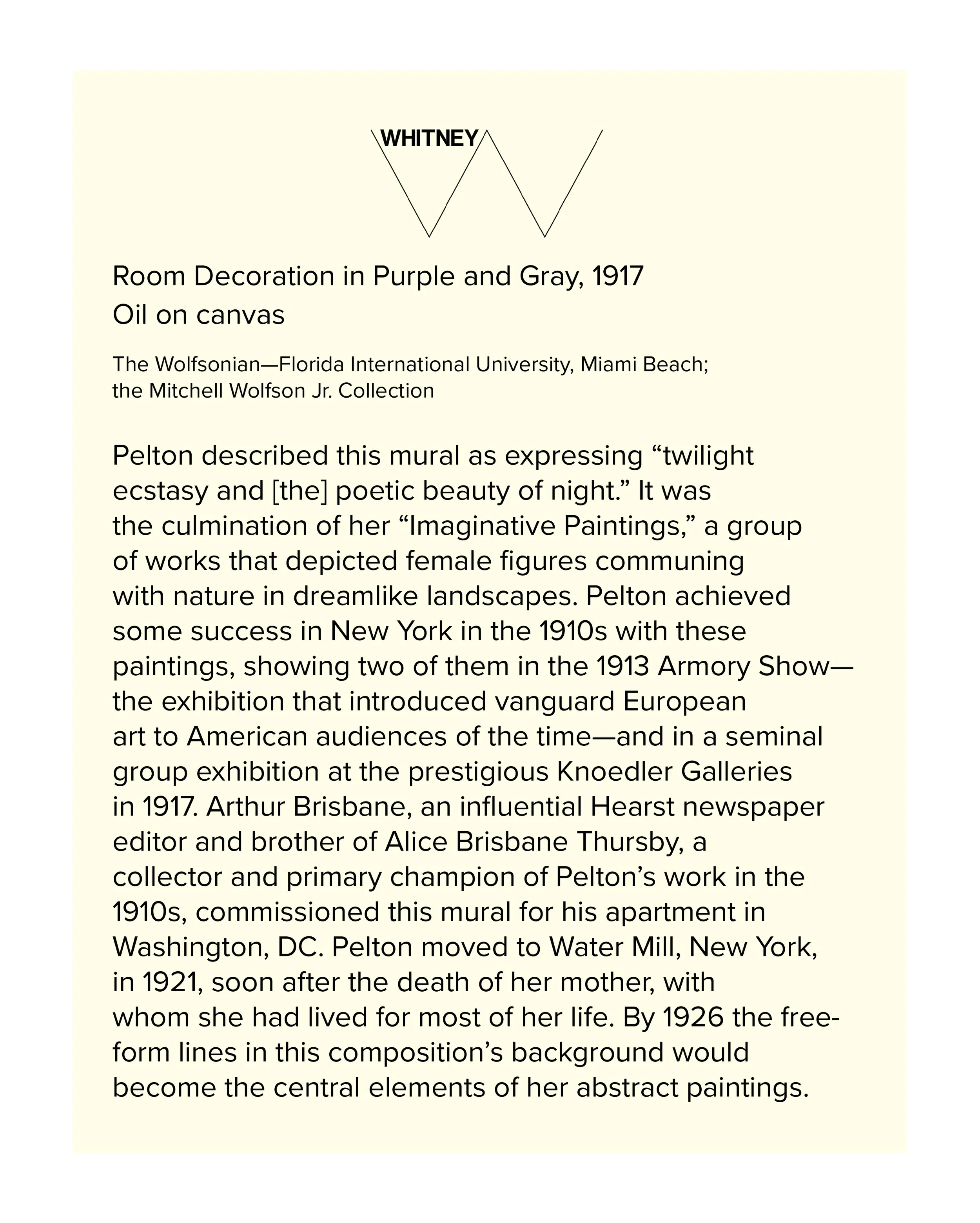
Room Decoration in Purple and Gray, 1917 Oil on canvas. The Wolfsonian—Florida International University, Miami Beach; the Mitchell Wolfson Jr. Collection
⬥
FRIENDS & INFLUENCES
The Desert’s Spiritual Power: A Formative Encounter in the New Mexico Landscape
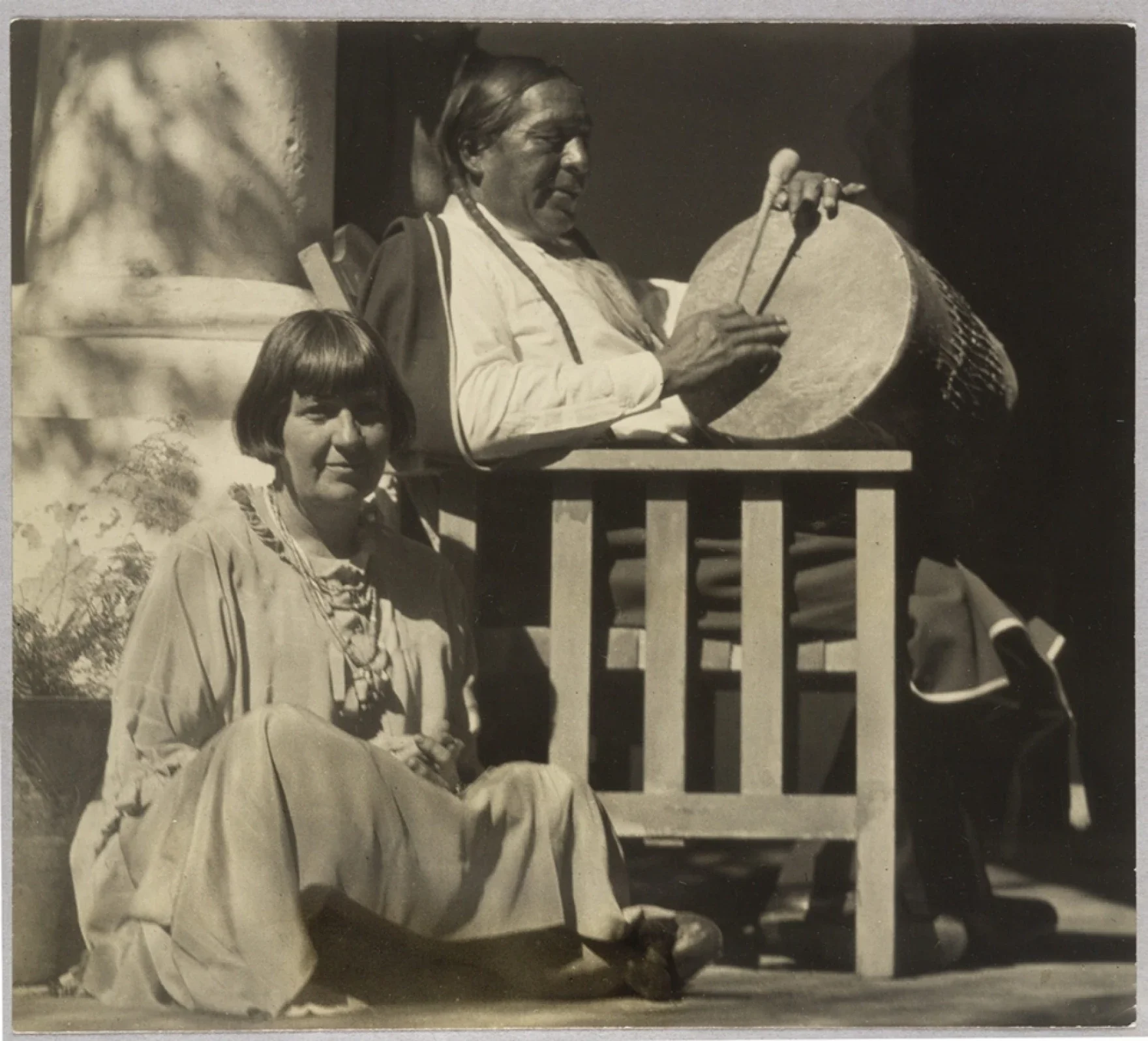
In 1917, writer, activist and socialite Mabel Dodge Luhan moved to Taos, New Mexico, using her influence as a wealthy patron to draw modernists and intellectuals from New York and Europe to the region. Her home became a famous salon, a hub for creativity that bridged Native American culture with the modern art world. Having previously helped organize the landmark 1913 Armory Show, Mabel Dodge invited Agnes to visit her in Taos.
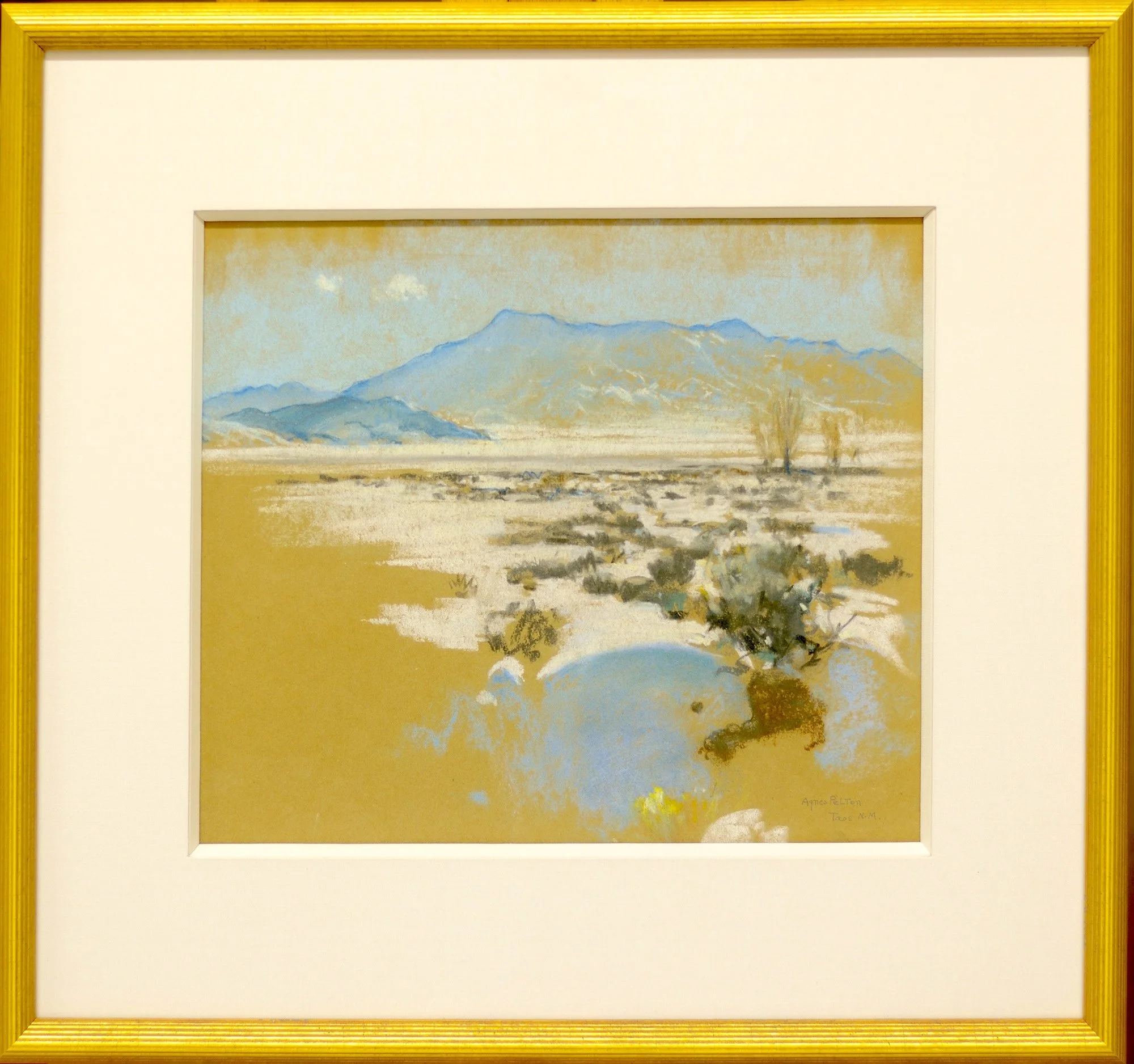
For Agnes, this visit was a formative encounter. Within this luminous world of open sky and collective inquiry, she first discovered the desert’s spiritual power. Pelton’s love affair with the desert skies began at Mabel’s salon, where the unique landscape and culture profoundly influenced her work and fueled her artistic discovery. Mabel hosted a legendary circle of guests, including Georgia O’Keeffe, D.H. Lawrence, Ansel Adams, Willa Cather, and Carl Jung.
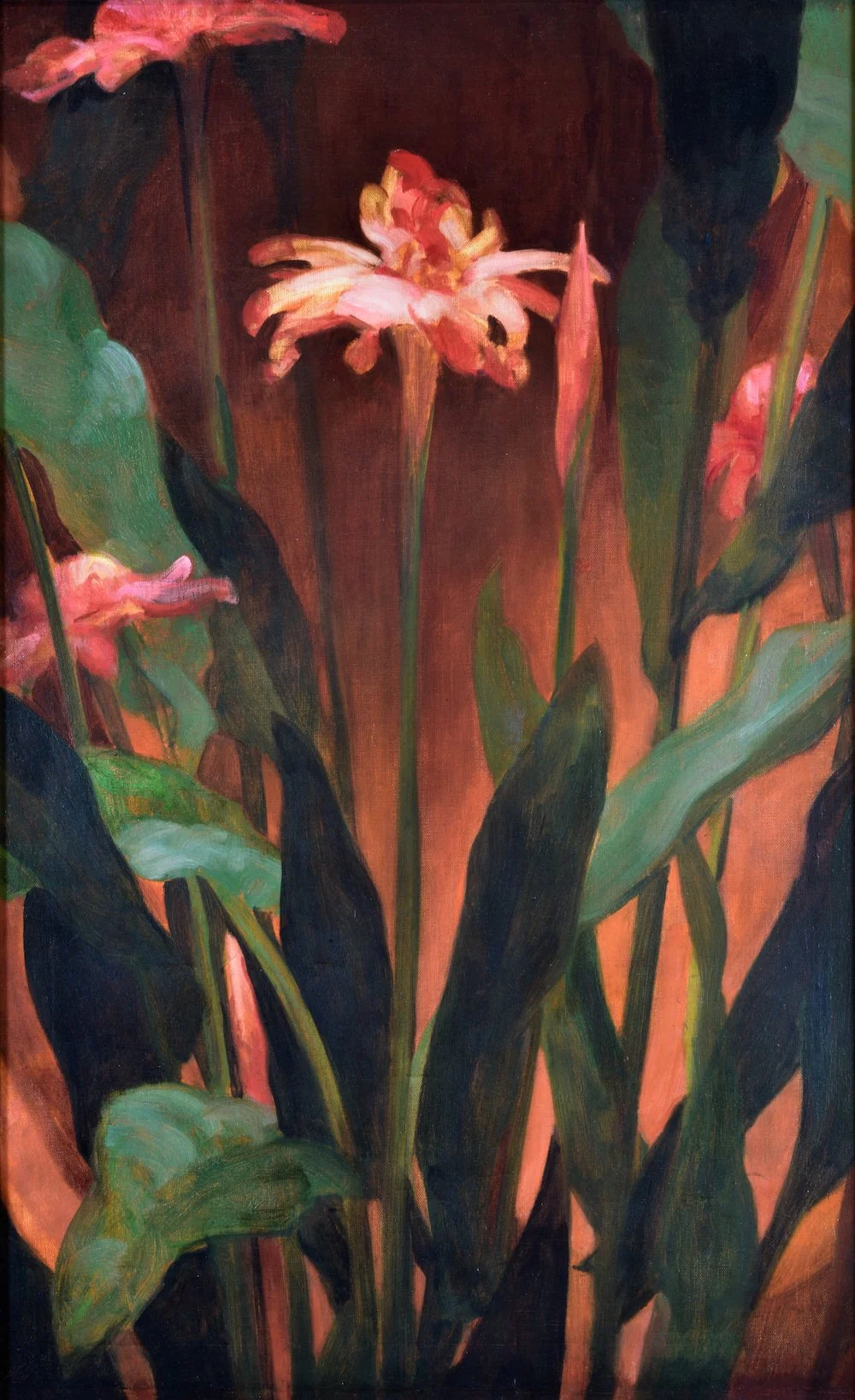
Before finding her home in the desert, Pelton traveled widely—to Hawaii, Beirut, Syria, Georgia, and throughout California. In Hawaii, during 1923 and 1924, she painted portraits and still lifes that reflected both her technical mastery and her growing sensitivity to atmosphere. She exhibited her work in New York at the Argent Galleries and at the Museum of New Mexico. By that time, she had already participated in twenty group exhibitions and fourteen solo shows.

CATHEDRAL CITY LIFE
Tranquility, and Spiritual Illumination Beneath Desert Skies.
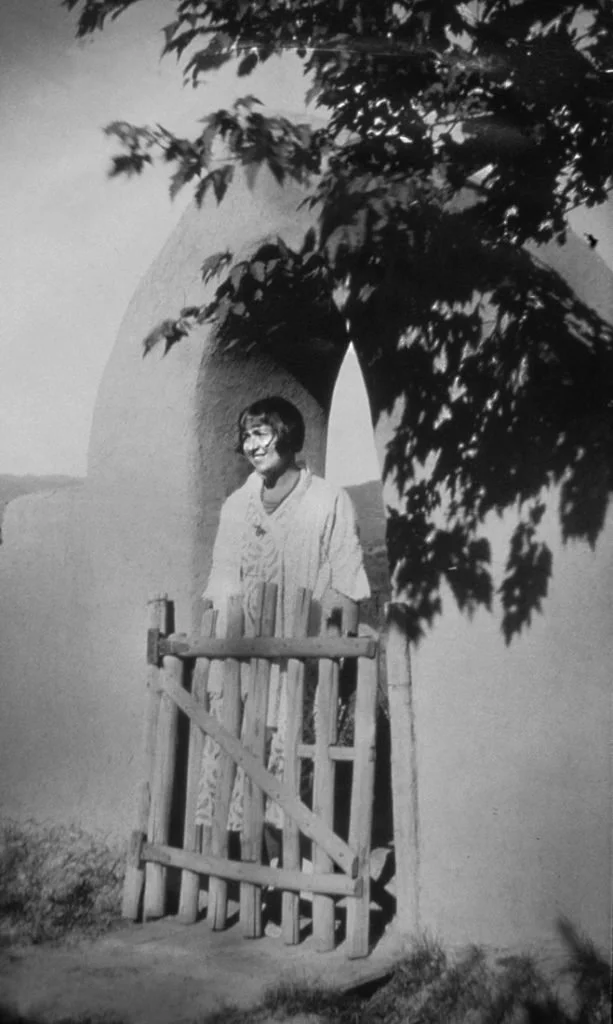
Pelton arrived in Cathedral City, California, in the early 1930s (circa 1932), intending only a short stay. The quiet expanse of the desert soon captivated her, and she made it her home for nearly thirty years.
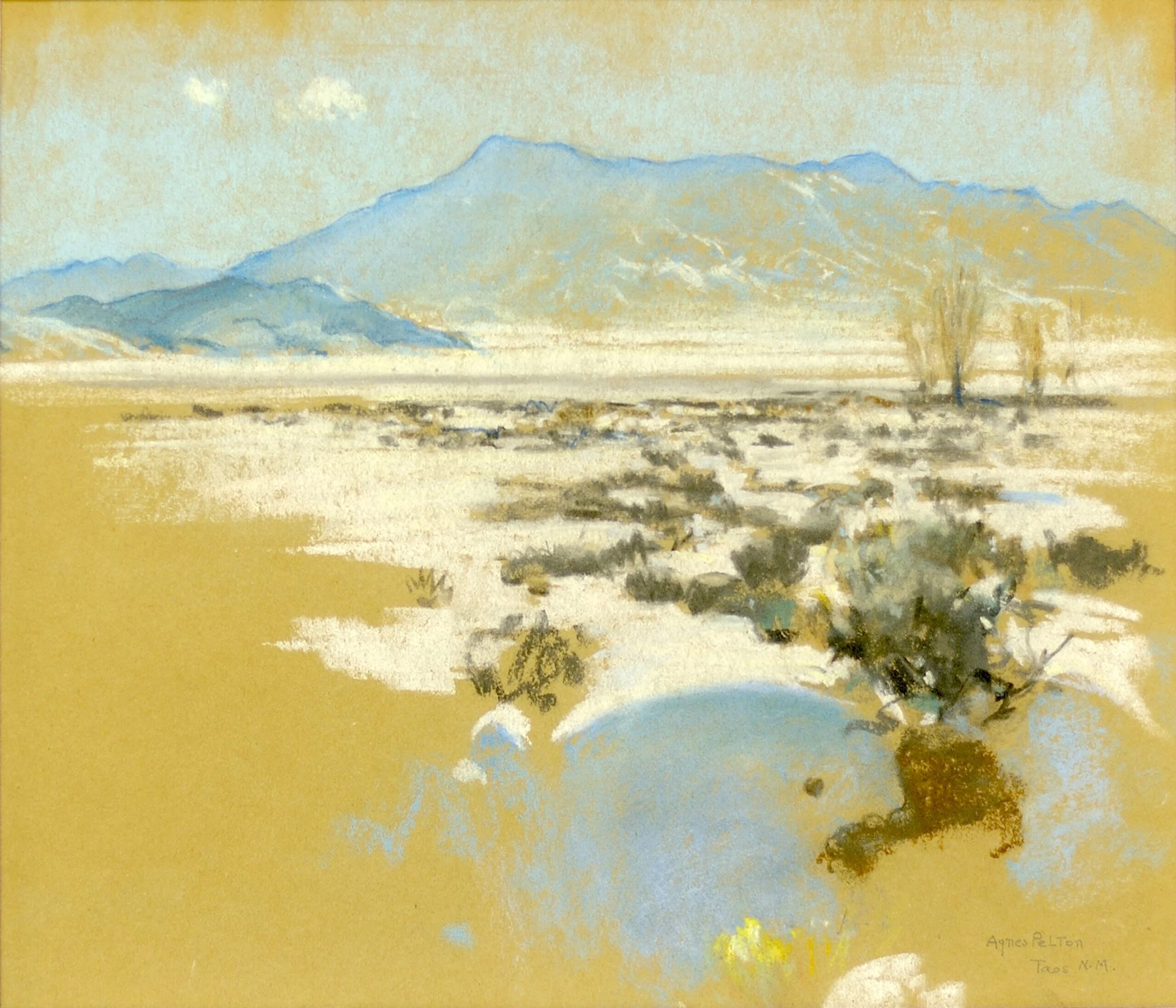
Beneath those vast skies, she found both solitude and inspiration to pursue her spiritual abstractions. To sustain herself, she painted western landscapes and commissioned portraits, each one a means to support the deeper calling that defined her life’s work and legacy.
On March 2, 1936—her father’s birthday, Pelton made a down payment on Lot #228 in the Cathedral City Development. She noted with quiet wonder how each stage of the process, from the bank loan to the construction of her home, aligned with a series of astrological signs she had been following. Two years later, in 1938, Mabel Dodge Luhan, her husband Tony, and the painter Dorothy Brett visited Pelton in Cathedral City, linking her desert retreat once again to the creative circle that had first drawn her west.
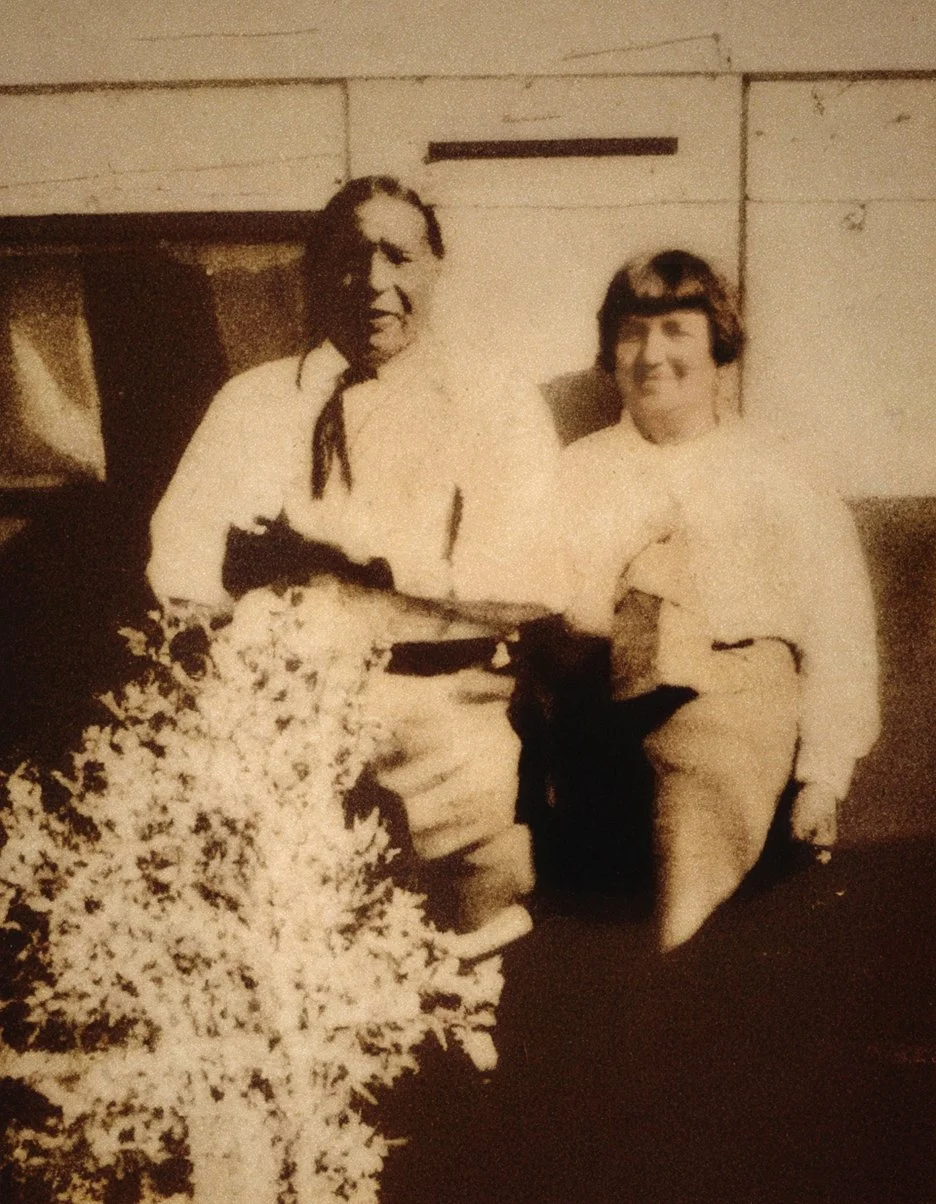
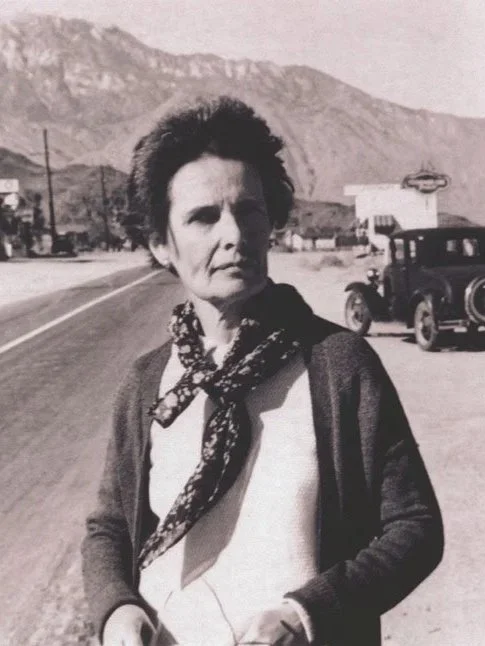
“The vibration of this light, the spaciousness of these skies enthralled me. I knew there was a spirit in nature as in everything else, but here in the desert it was an especially bright spirit.”
— Agnes Pelton
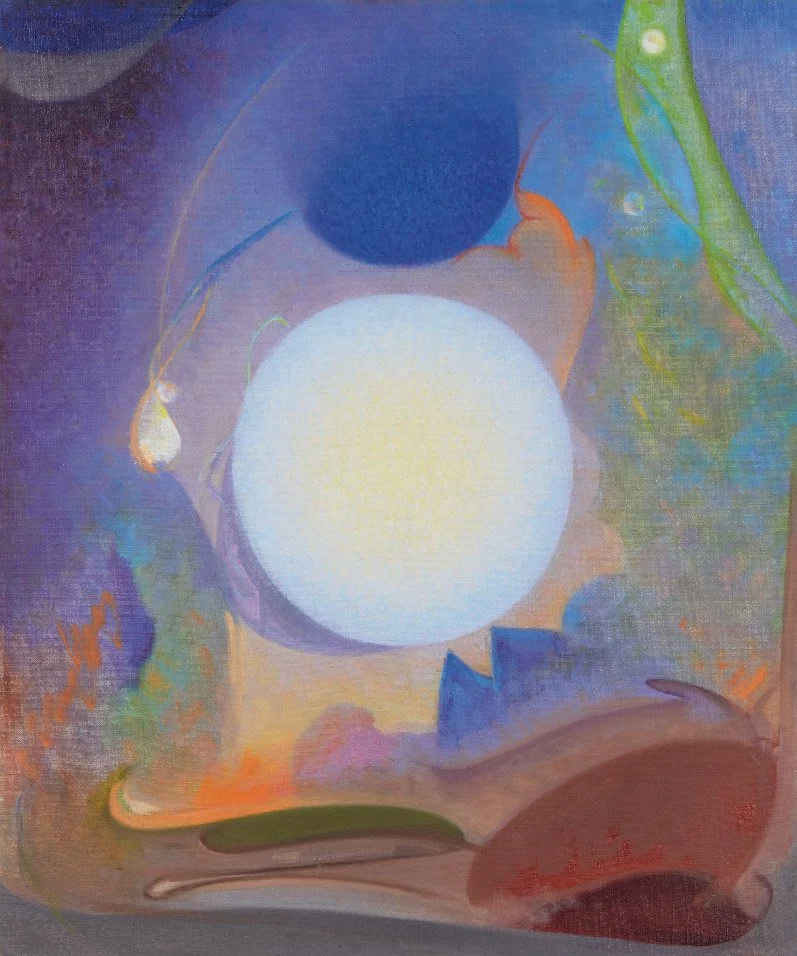
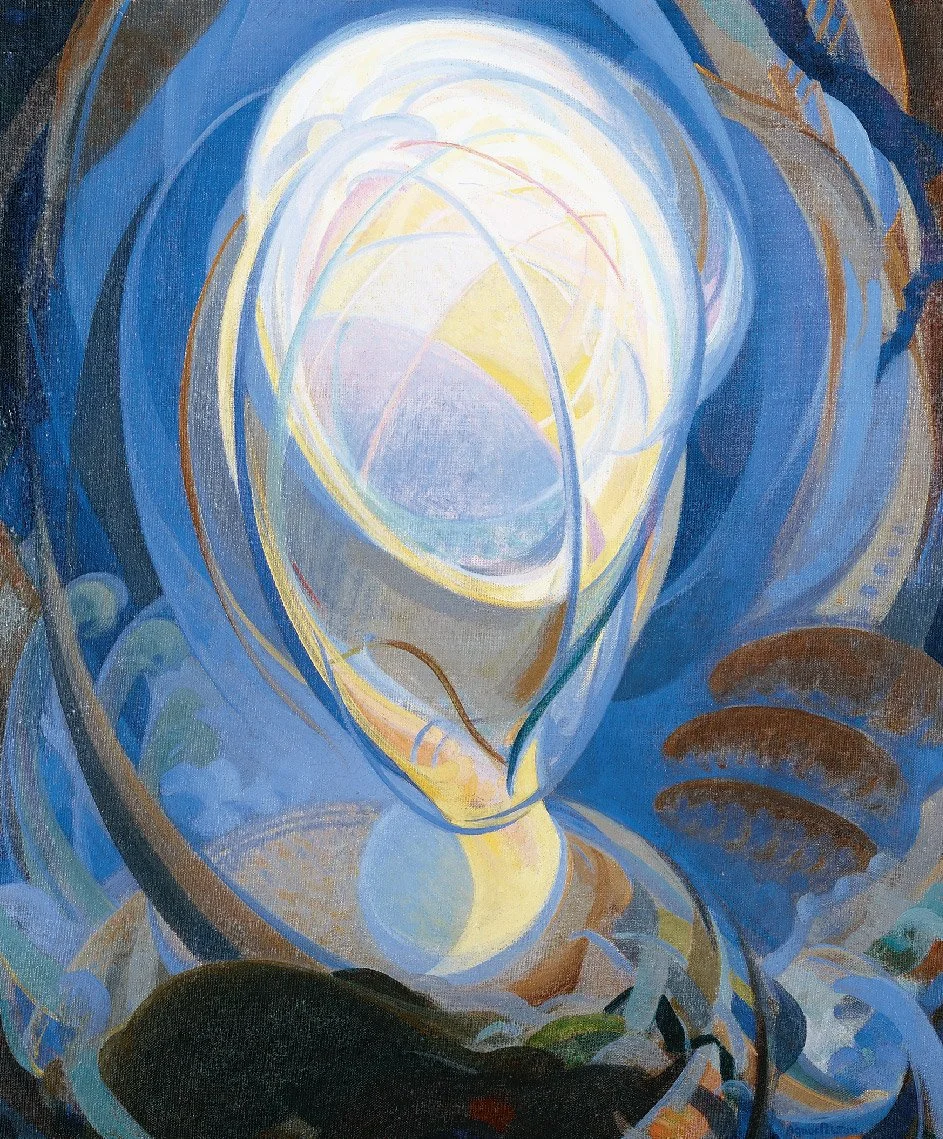
Agnes Pelton, Interval, 1950. Photograph by Peter Palladino. Courtesy of the Agnes Pelton Society. Bridgeman Licensing →
Interval is one of Pelton’s works that returns to the circle as both form and meaning. With no beginning or end, it suggests continuity and wholeness while guiding the eye inward. Here, the circle holds a quiet balance, a still center of contained energy.
In the desert Agnes had found home, inspiration and connection. She would make life long friendships and create her lives work, pieces that are now considered her masterworks.
A Life Shaped by Light
As Agnes Pelton made the desert her home, she began to flourish both spiritually and creatively. Those who knew her described a kind, modest, and open soul. In the desert she found not only inspiration, but also a circle of friends and fellow artists.
Pelton became part of the growing art community in Cathedral City. She taught classes at local galleries and welcomed neighbors and visiting artists into her studio. Like Mabel Dodge Luhan before her, she opened her home to others, hosting informal gatherings and weekend open studios.
Artists exhibited their work on Pelton’s walls, turning her home into a temporary gallery. Friends and fellow painters gathered there to share techniques, discuss ideas, and exhibit their work together. Pelton was not the organizer of this circle so much as a generous participant within it. She contributed her space, her encouragement, and her friendship.
Pelton’s home studio was the precursor to the Desert Art Center. In time, this small but dedicated community of artists organized and fundraised to establish a new home. Pelton donated one of her landscapes, Smoke Tree in Bloom, to the cause. The painting was auctioned, and the proceeds—$1,000, roughly $20,000 today—became a major step toward securing a permanent home for the Art Center.
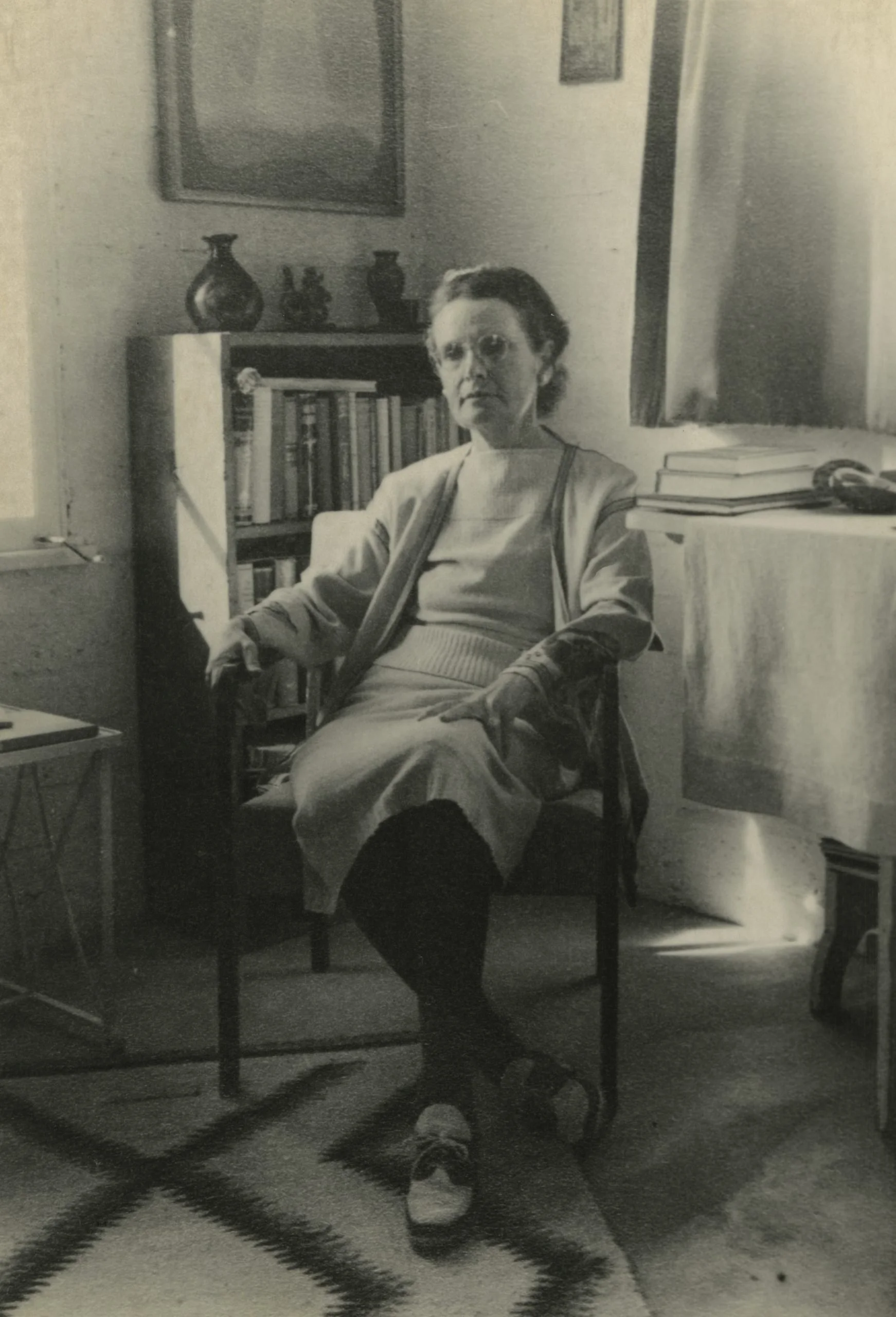
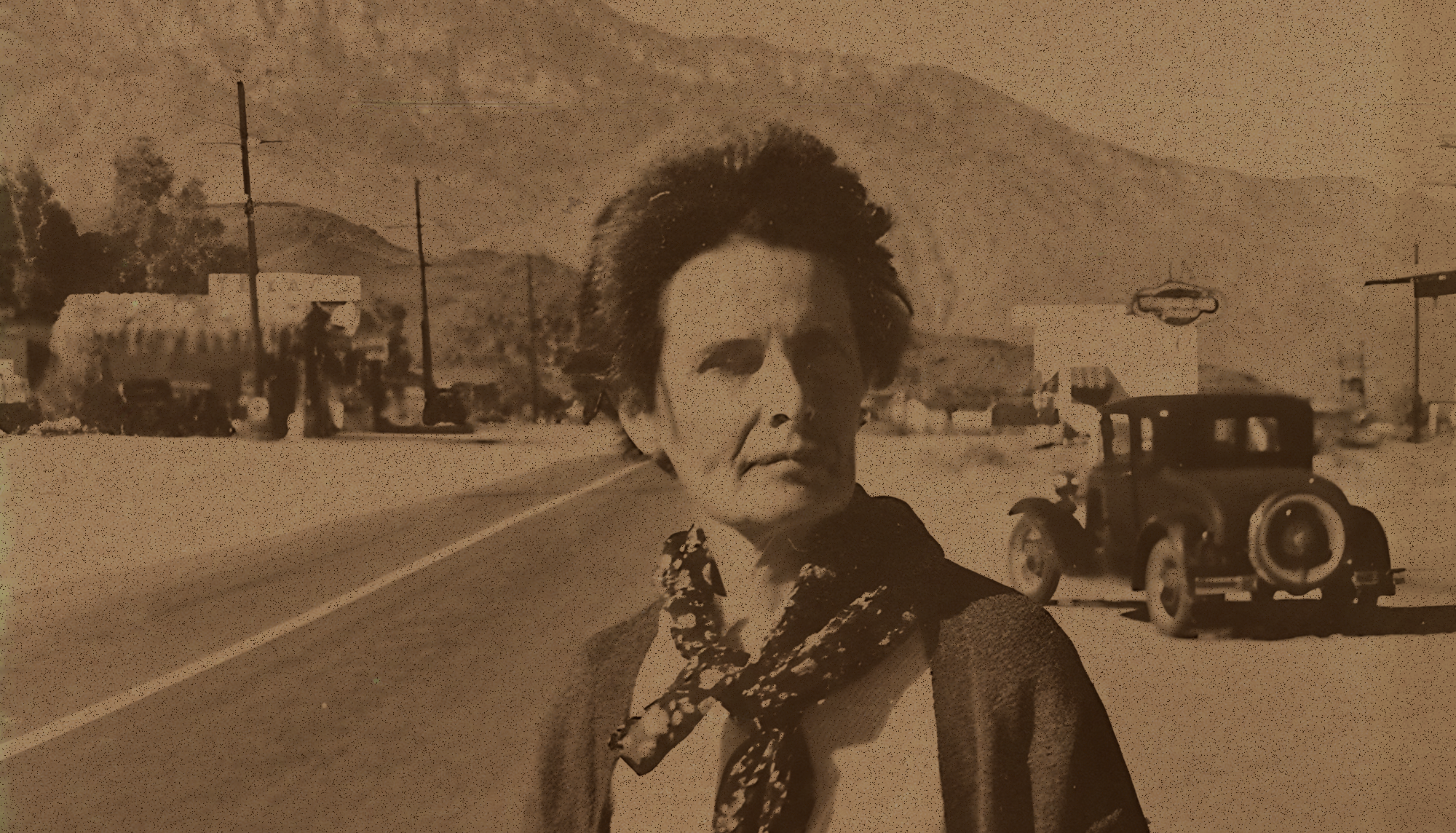
AI-generated reenactment of Agnes Pelton in Cathedral City, after settling into her new home. Based on an original photograph .
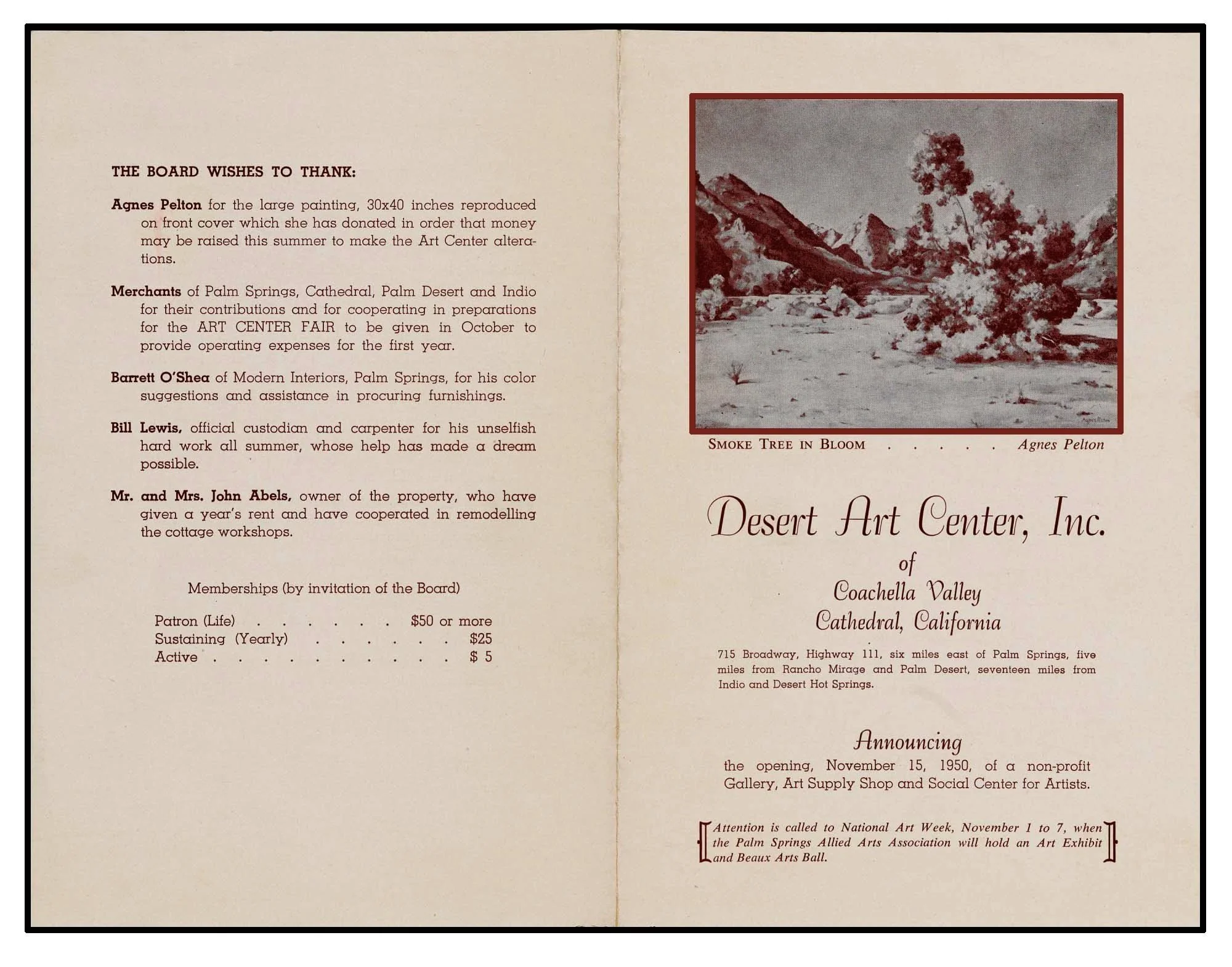
Open booklet with text on the left page thanking individuals for contributions to an art center, and a photograph of a smoke tree in bloom on the right page, with the caption "Smoke Tree in Bloom" and the artist's name Agnes Pelton.
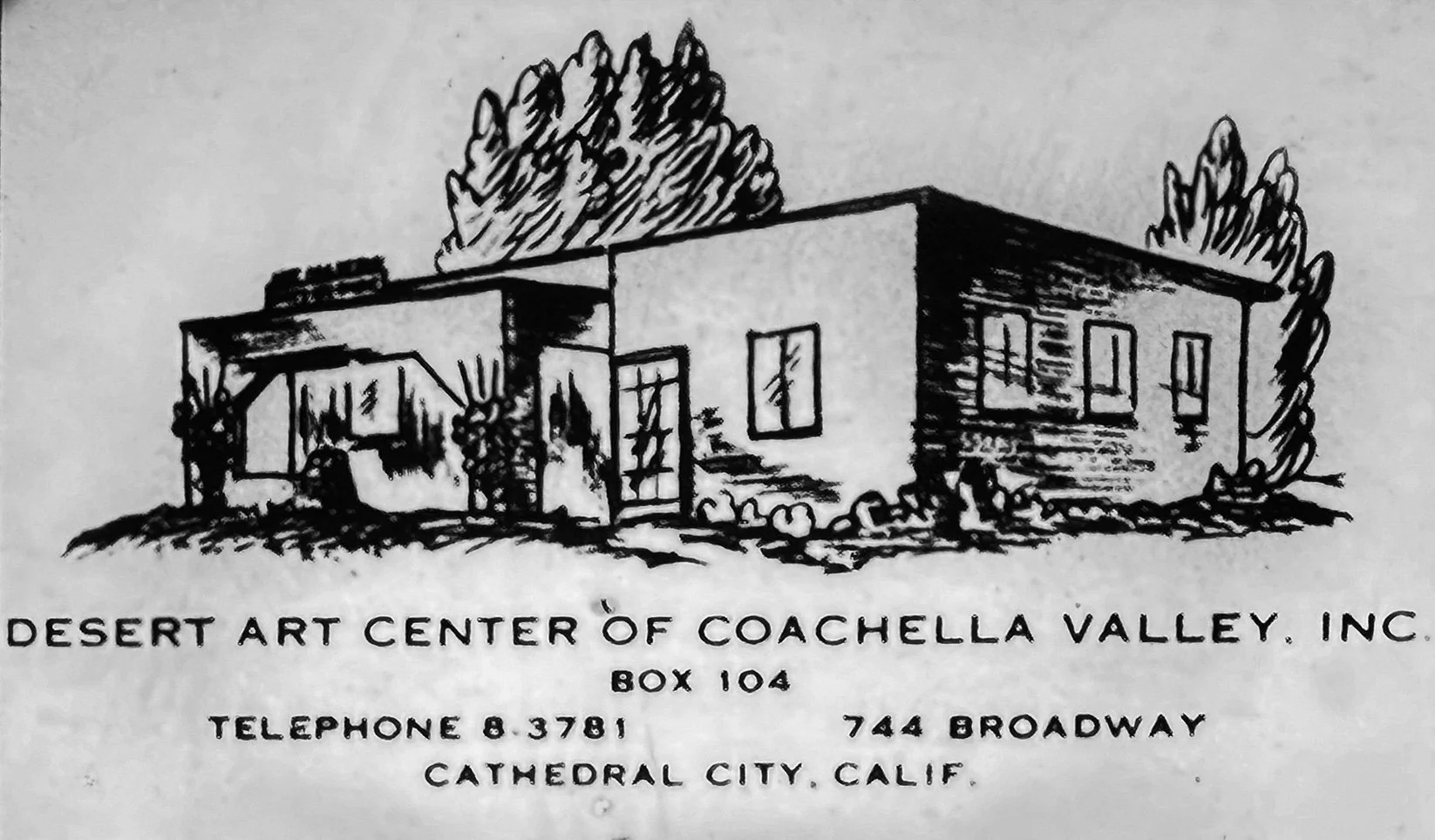
A black and white sketch of the Desert Art Center of Coachella Valley, Inc., a building with trees in the background. Text below indicates the address in Cathedral City, California, and includes a telephone number.
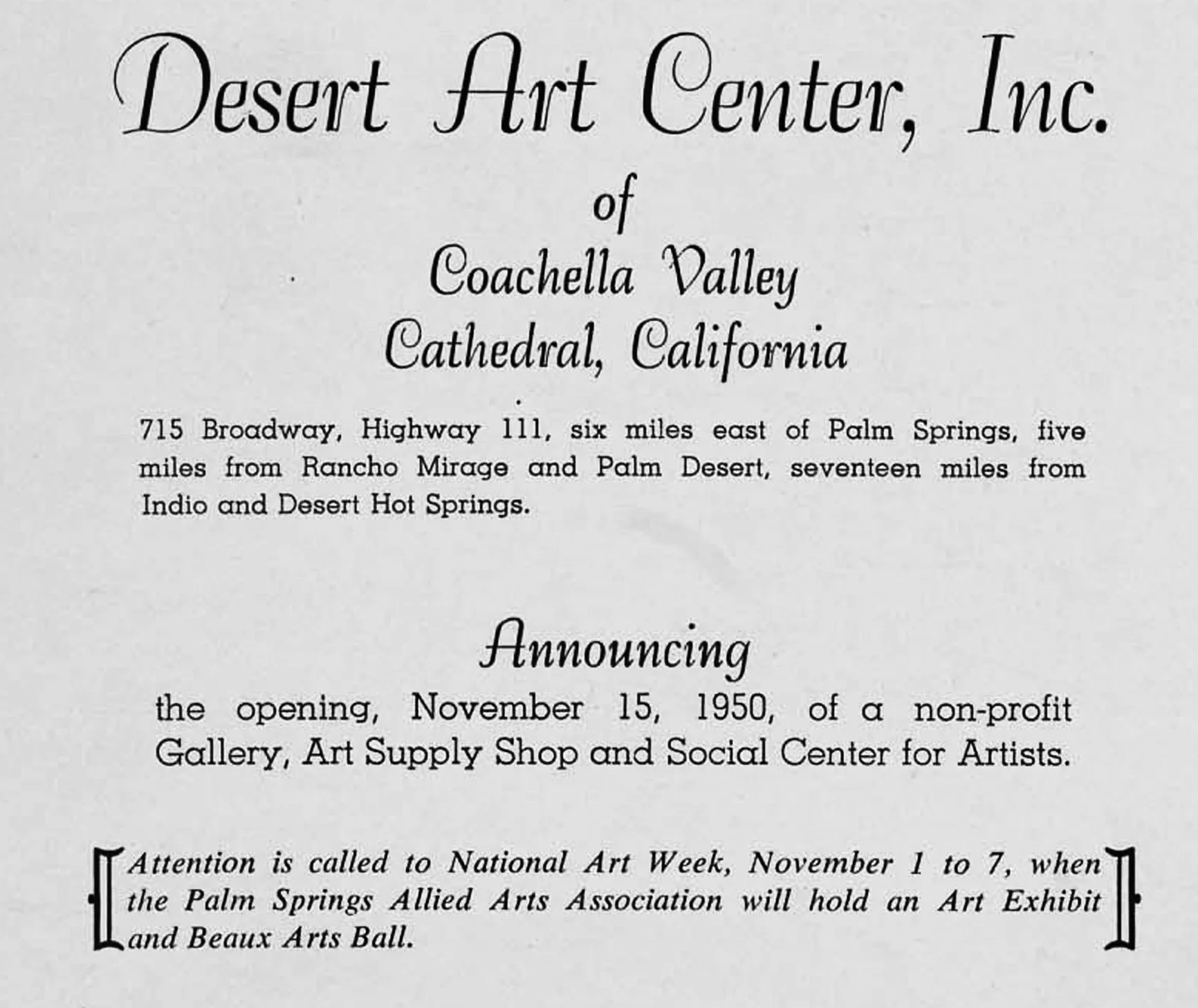
A scanned document announcing the opening of Desert Art Center, Inc. in Coachella Valley, California, on November 15, 1950, at the Palm Springs Allied Arts Association.
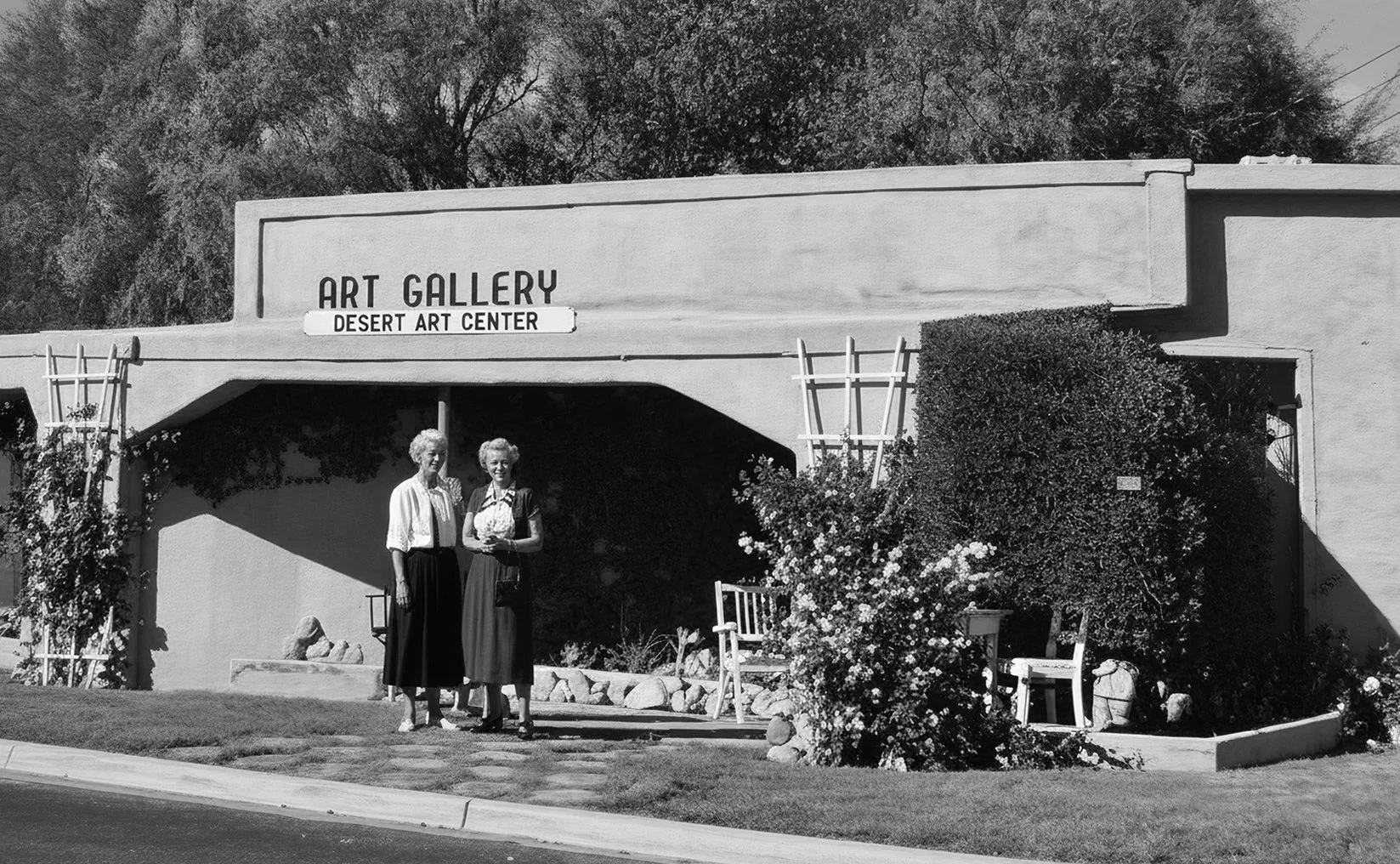
Two women standing in front of a small art gallery building with a sign that reads "ART GALLERY DESERT ART CENTER." The women are smiling; one wears a light-colored blouse and the other a darker dress. There are plants, bushes, and a bench near the entrance, with trees in the background.
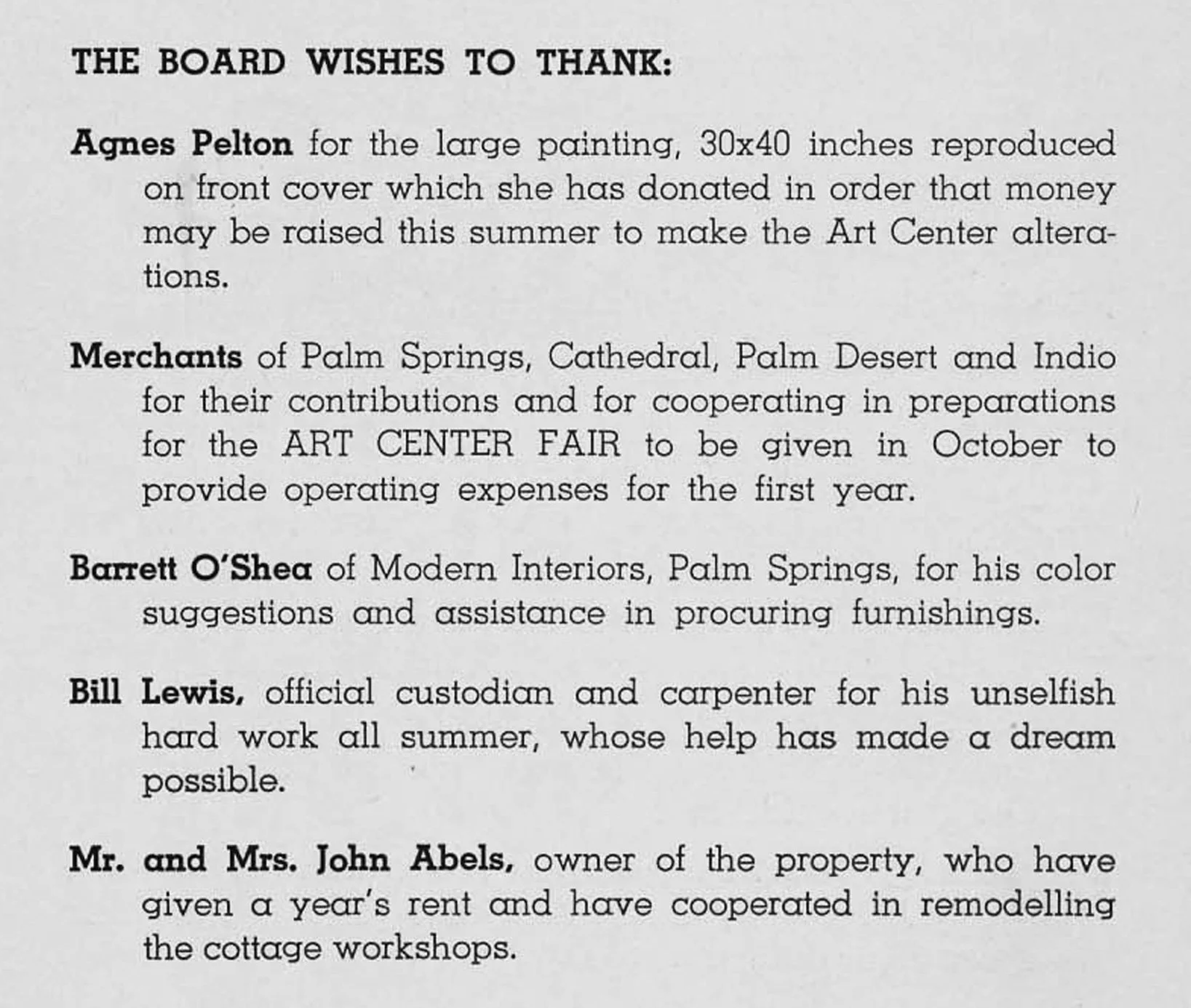
A printed page with a list of acknowledgments and thanks, including names such as Agnes Pelton, Merchants of Palm Springs, Barrett O’Shea, and Bill Lewis, among others.
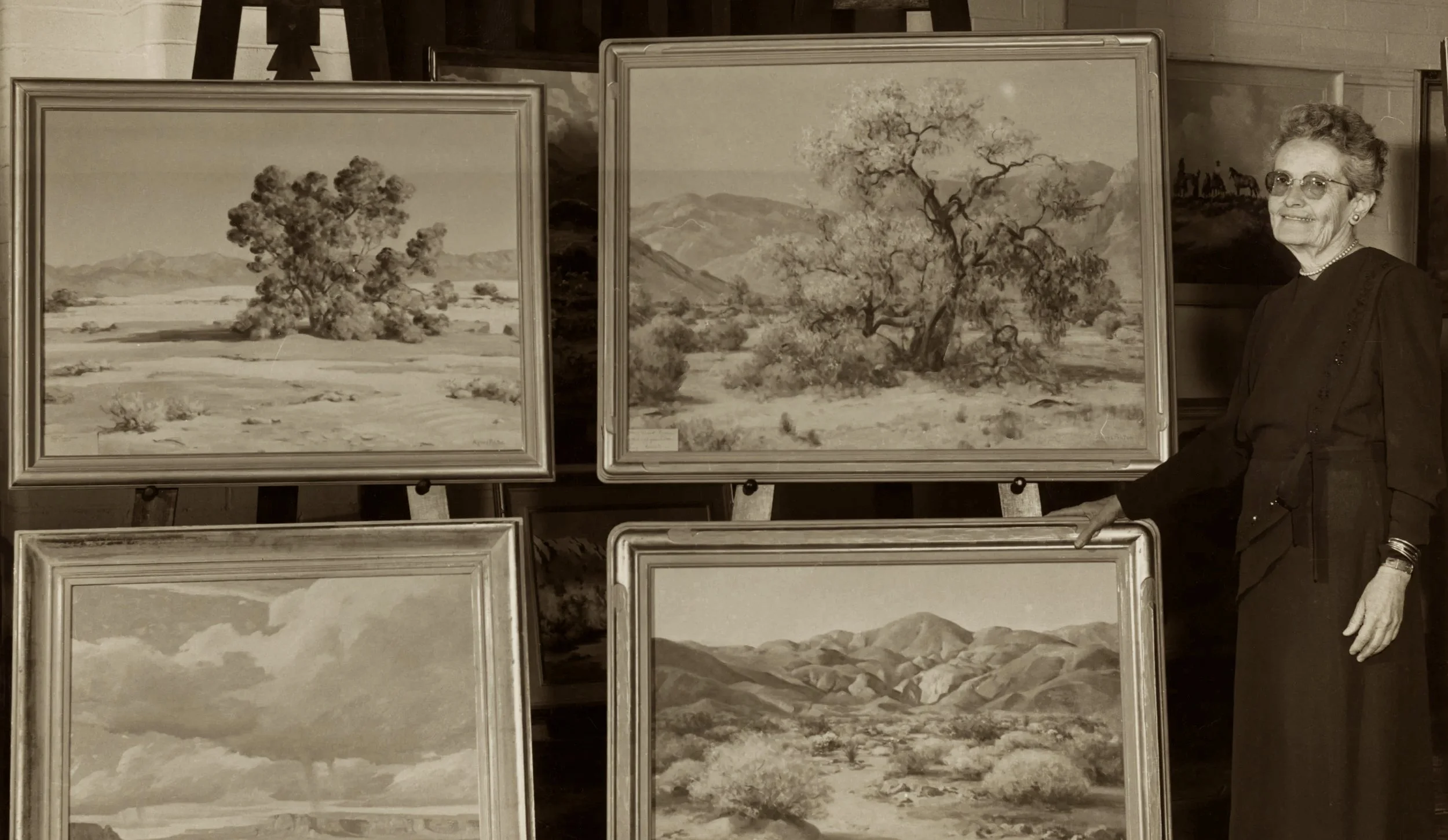
Agnes Pelton with glasses and a pearl necklace smiling while standing next to her framed landscape paintings at an art exhibition.
“Saturday and Sunday afternoons there was quite an ‘occasion’ here in my studio. For three days previously, two young men, artists, worked on changing my room into a gallery… and then the first art exhibit ever held in Cathedral City took place. Works of Cathedral City artists only—oil, watercolor, black print, etc. We had tea, and a hostess to pour, and during those two afternoons at least 200 people came.”
⬥
— Agnes Pelton
Agnes Pelton, Smoke Tree In Bloom. Oil on canvas, 30 x 40 inches. Courtesy of the Agnes Pelton Society. ¹Exhibition organized by the Palm Springs Art Museum, curated by Christine Giles.
Smoke Tree in Bloom was donated by Pelton to support the founding of the Desert Art Center. Auctioned for $1,000 (about $20,000 today), the painting played a key role in raising funds for the organization’s first permanent home. “Pelton had high regard for the natural beauty surrounding her and believed that every place had its own aura—which she referred to as ‘the voice of locality’ and tried to convey in her paintings. In her landscape paintings, referred to as ‘my deserts’, Pelton was especially fond of capturing the expansive vistas that stretched out to the horizon, the shroud of purple blooms that encased smoke trees in June, and the ancient timeless character of desert willows.”¹
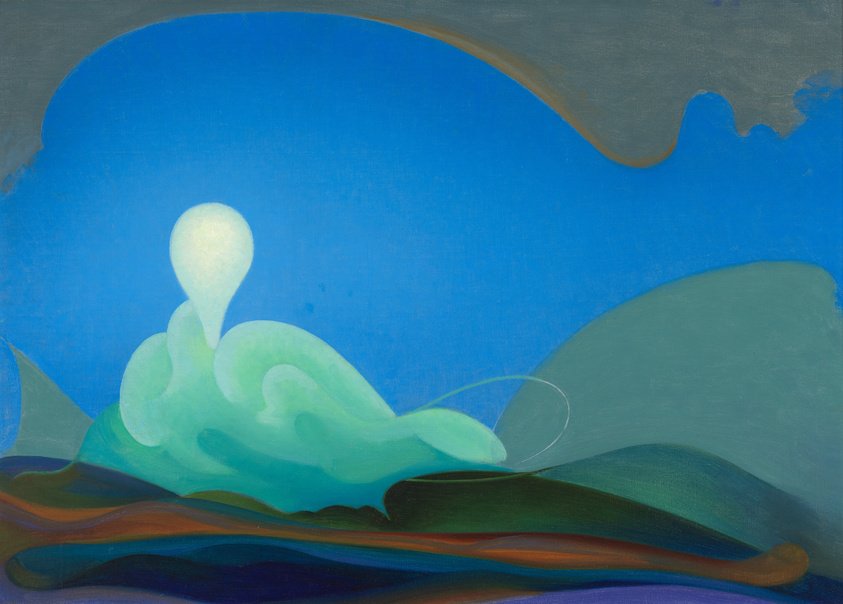
Agnes Pelton — Sea Change, 1931
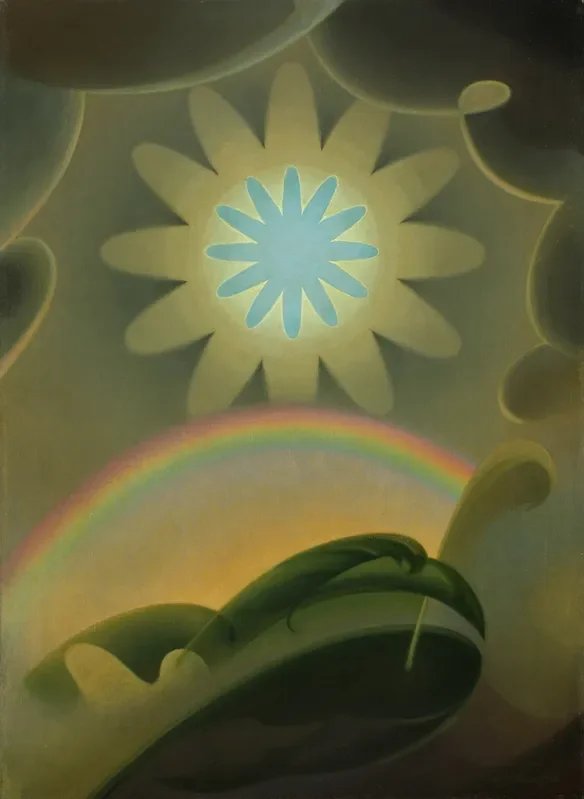
Agnes Pelton — Sand Storm, 1932
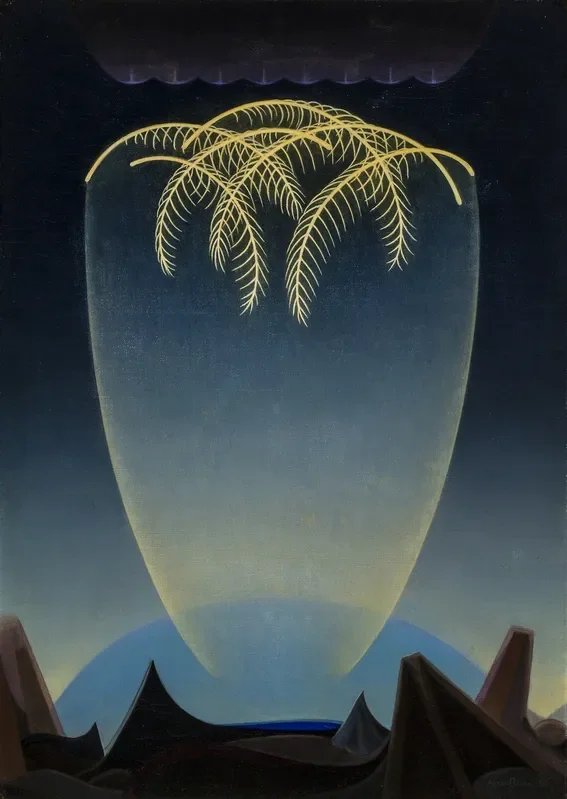
Agnes Pelton — Messengers, 1932
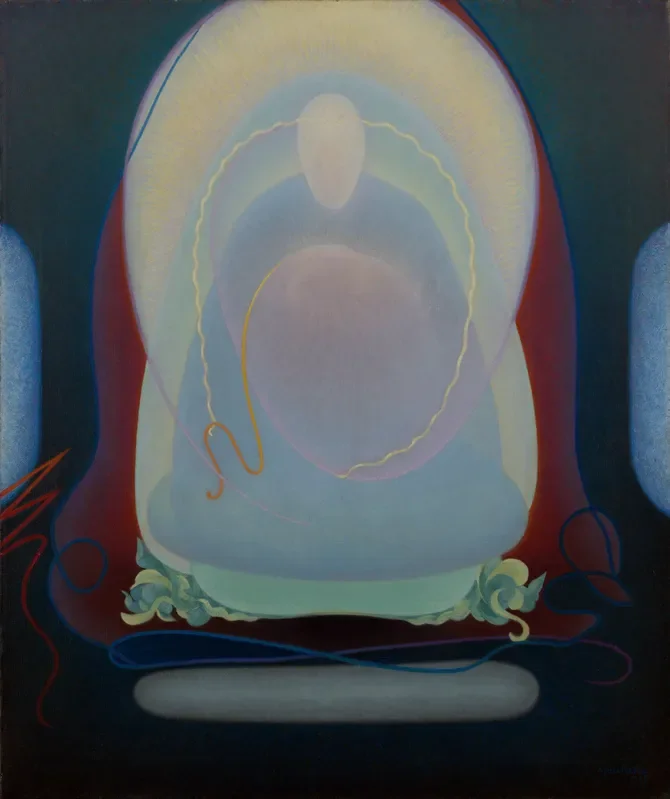
Agnes Pelton — Mother of Silence, 1933
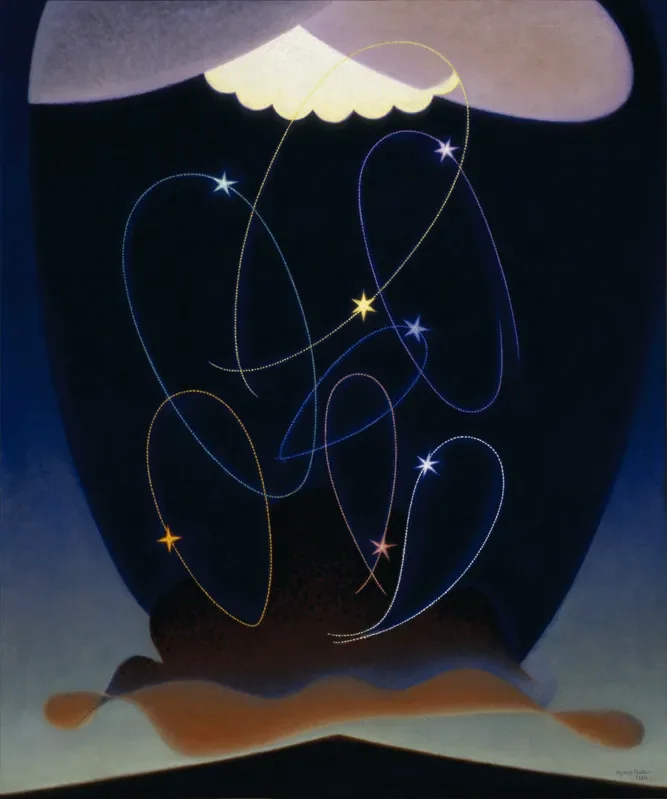
Agnes Pelton — Orbits, 1934
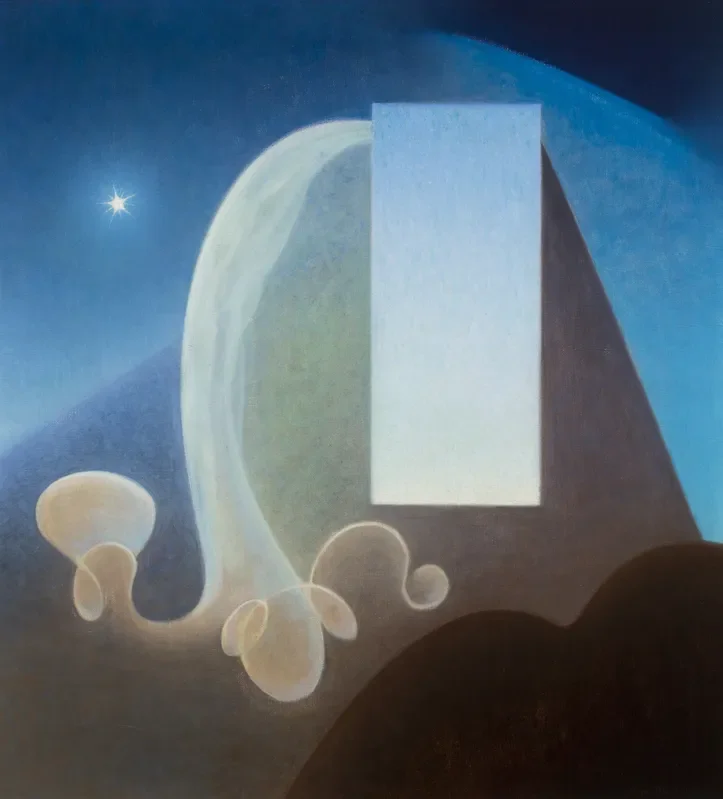
Agnes Pelton — Day, 1935
A Bridge to Higher Consciousness:
Agnes Pelton & The Transcendental Painting Group
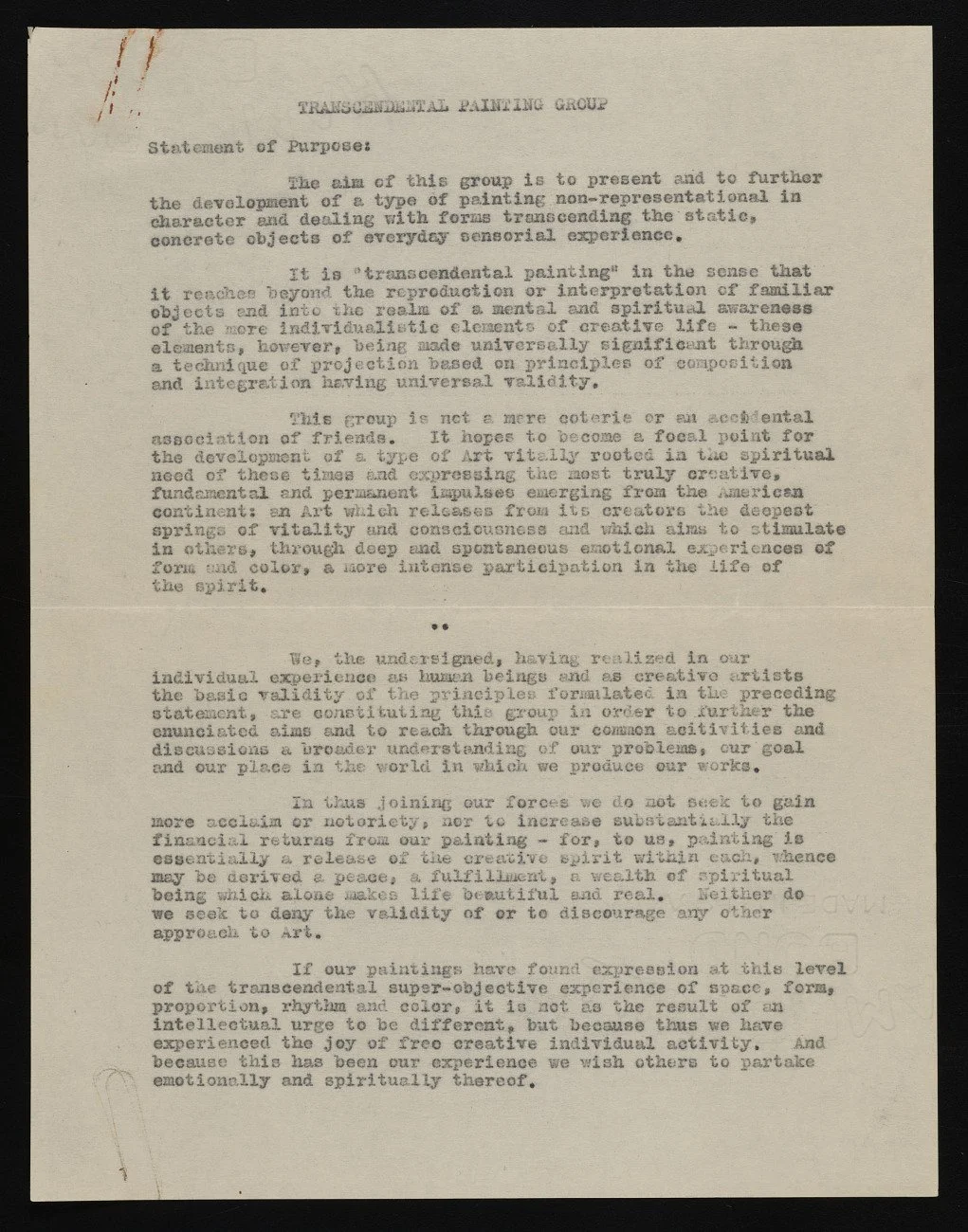
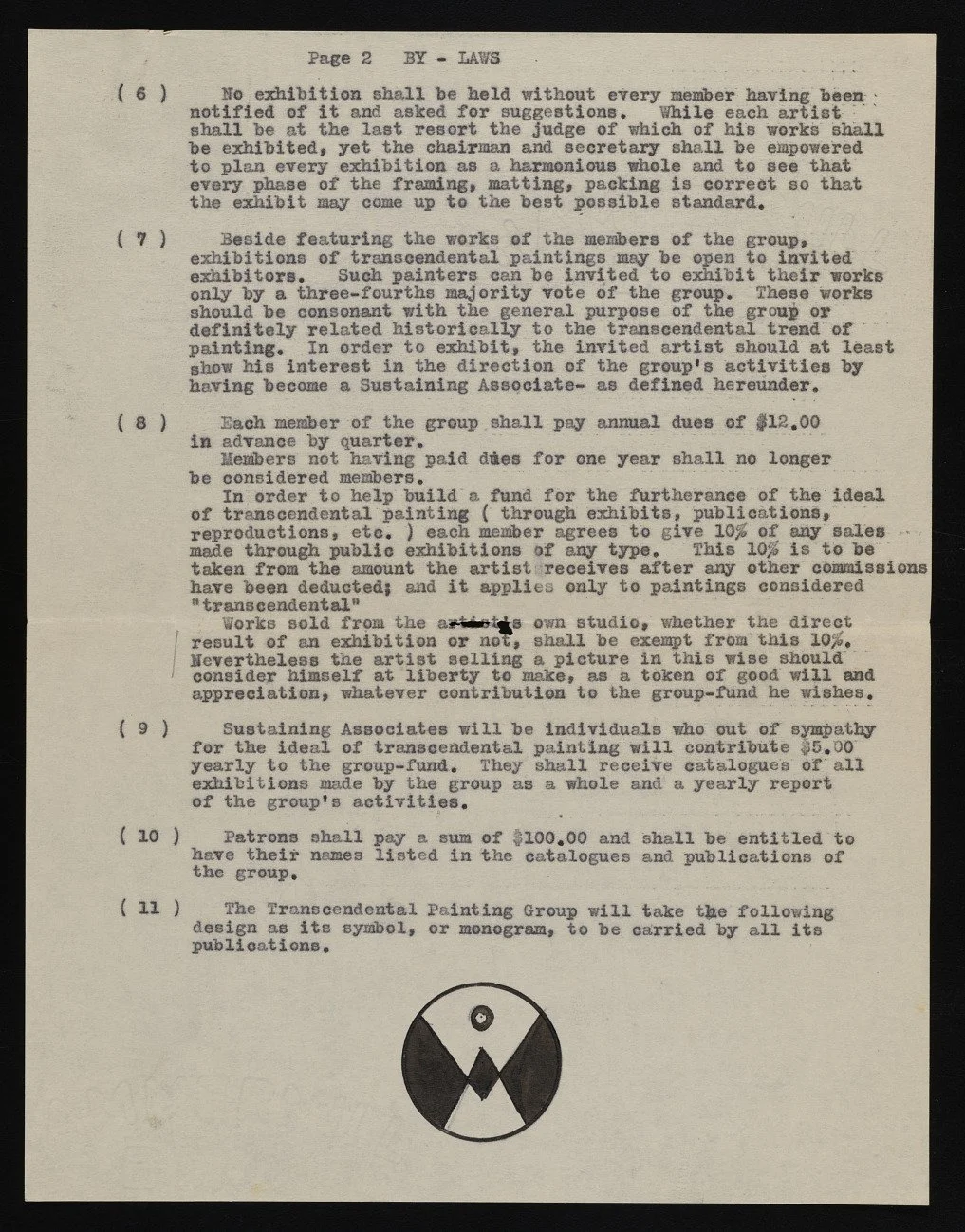
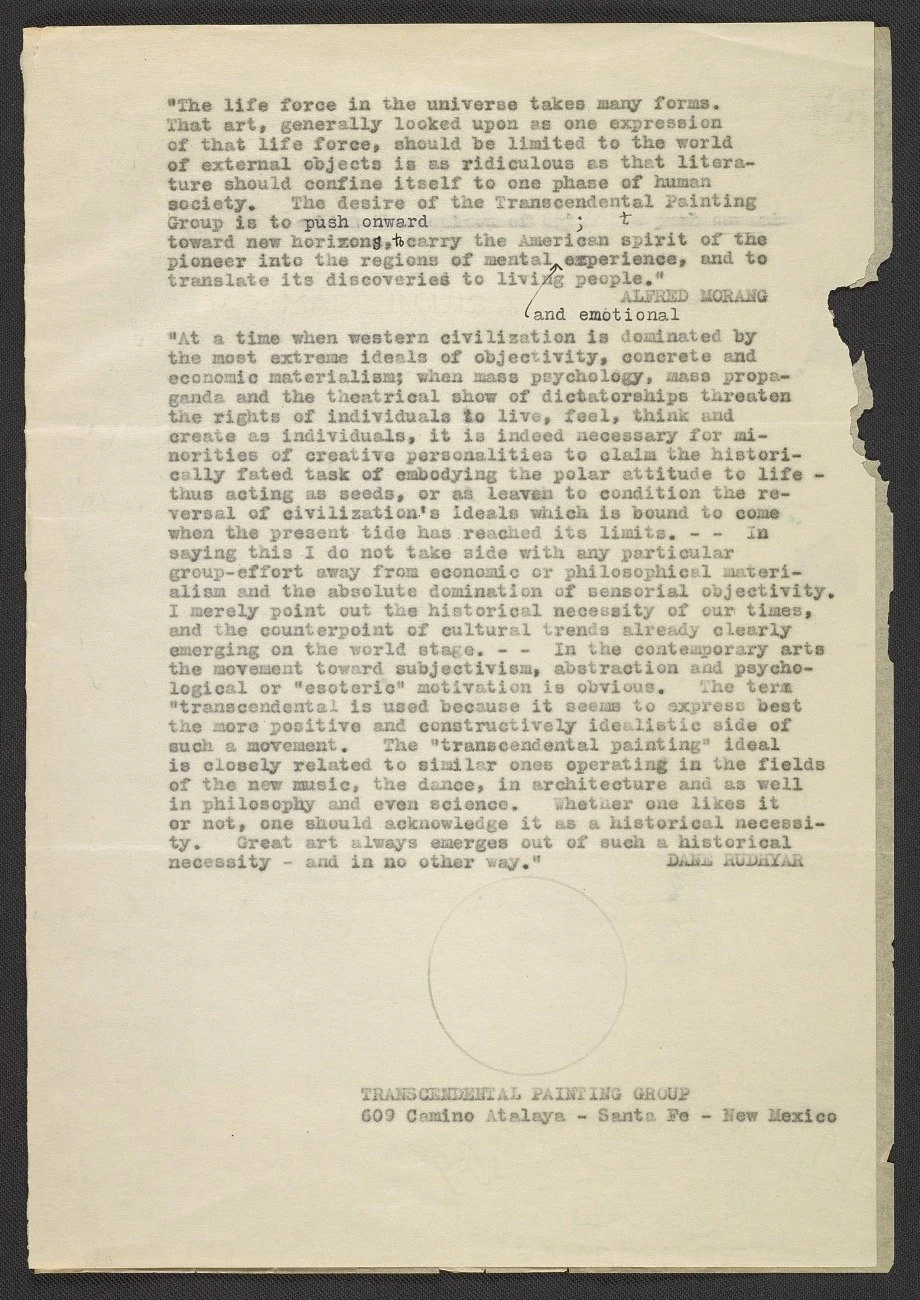
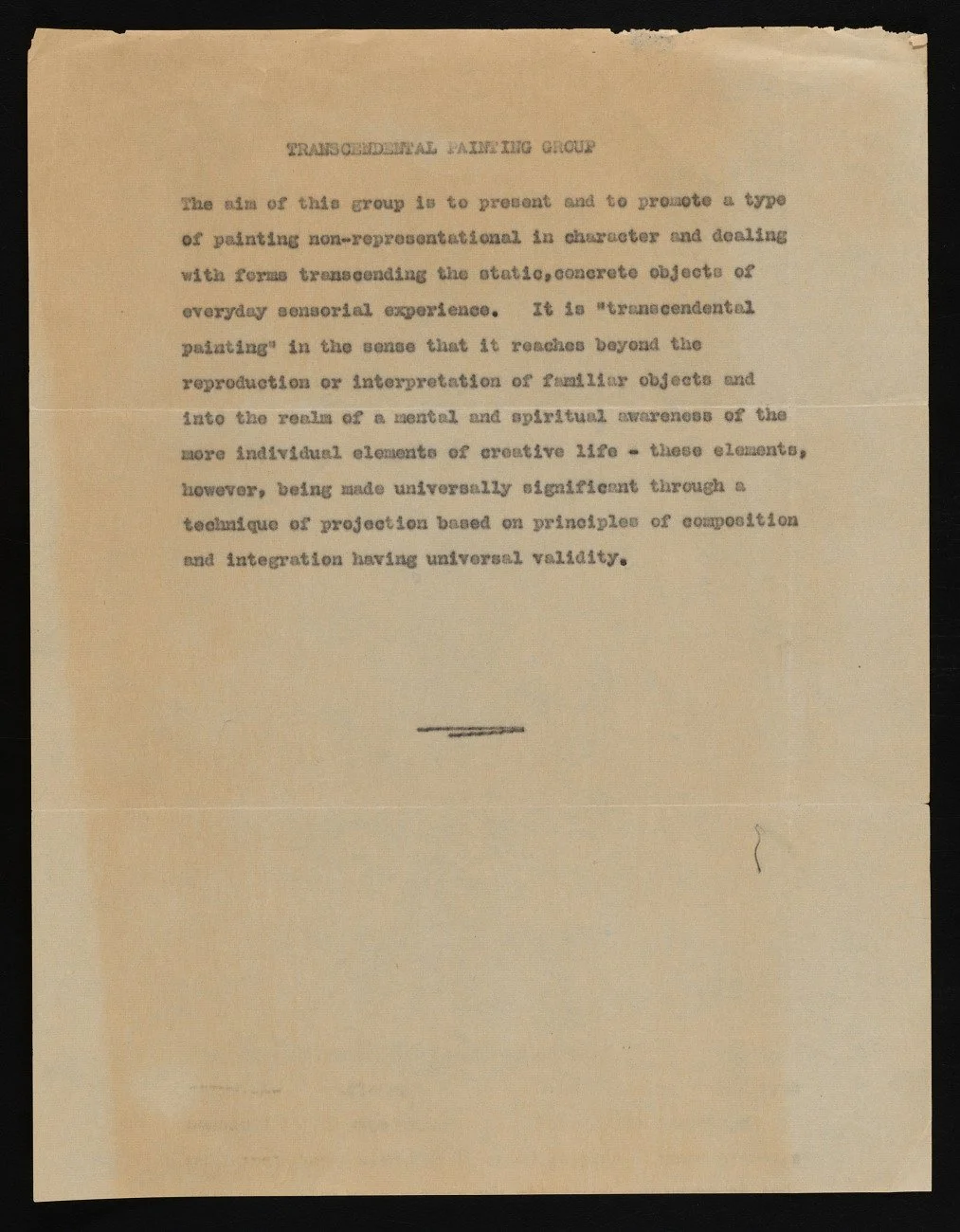
The Transcendental Painting Group took shape in New Mexico in 1938, bringing together artists working in and around Santa Fe and Taos, including Emil Bisttram, Lawren Harris, Raymond Jonson, and Florence Miller Pierce. Agnes Pelton was elected as a member in absentia, joining a collective united by a shared interest in spiritual abstraction. By the following year, their work was being shown more widely, with exhibitions in San Francisco, New York, and across New Mexico.
Much of Pelton’s work was shaped by her interest in Agni Yoga and its focus on fire as a guiding force. Through this lens, and her wider esoteric practice, she became an essential voice within the group, helping to define a shared aim to move beyond the visible world and use abstraction as a means of accessing higher states of awareness.
Influenced by theosophy and the rhythmic abstractions of Wassily Kandinsky, the group worked between geometric structure and intuitive expression. Their paintings often approached synesthesia, seeking to translate the unseen into harmonies of color and light. Though the group dissolved in 1942, its vision endured in the belief that art could serve as a bridge to expanded consciousness.

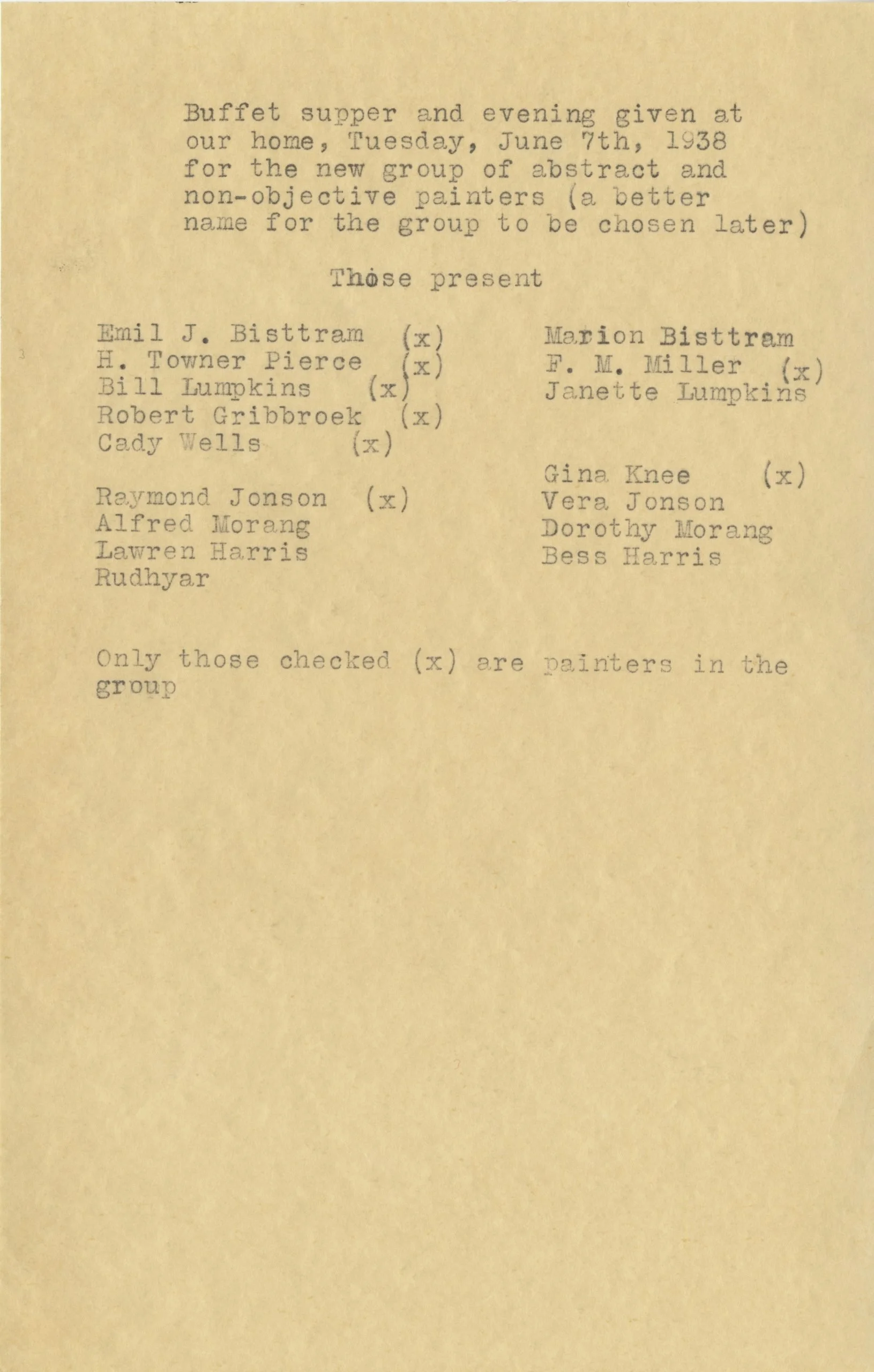
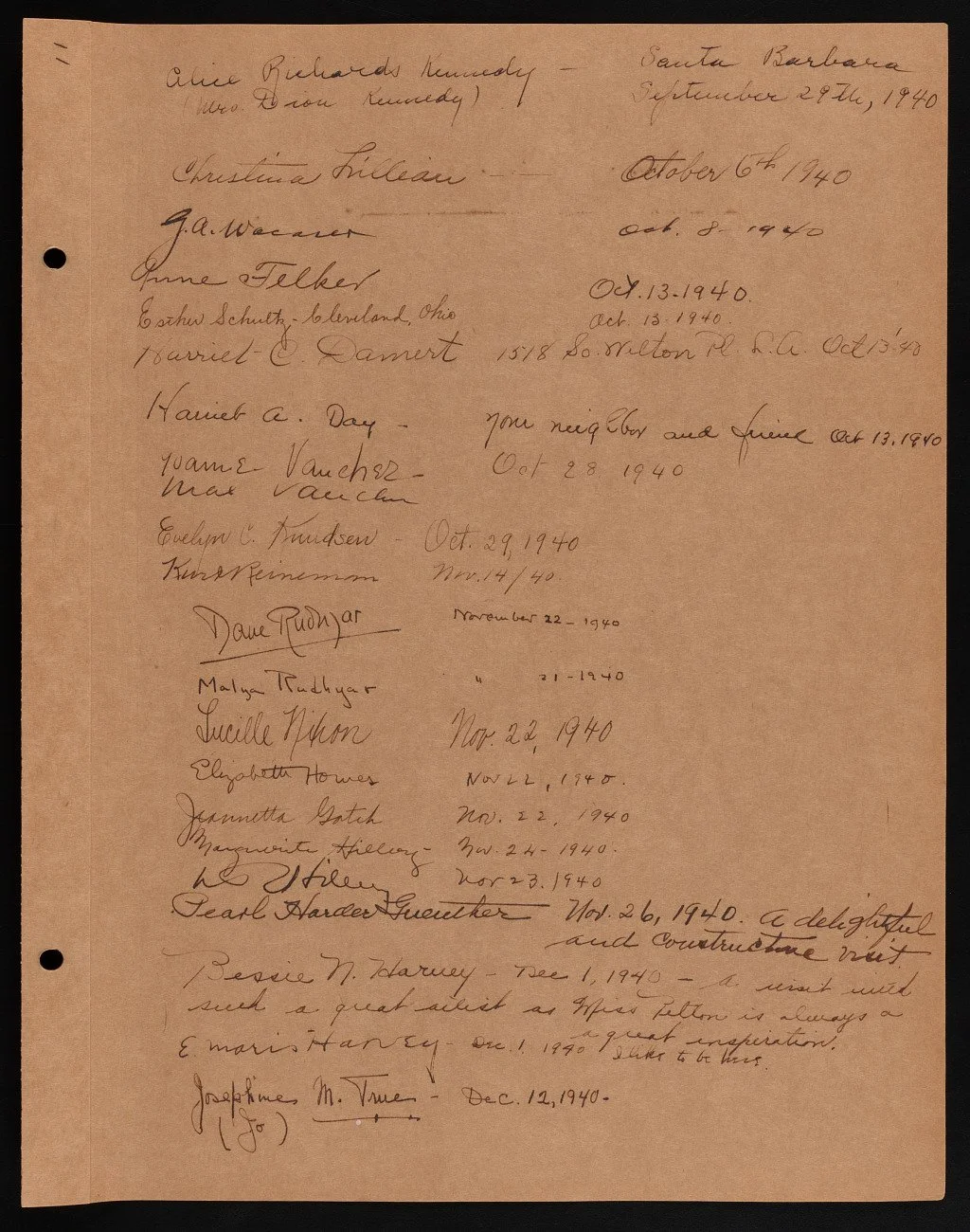
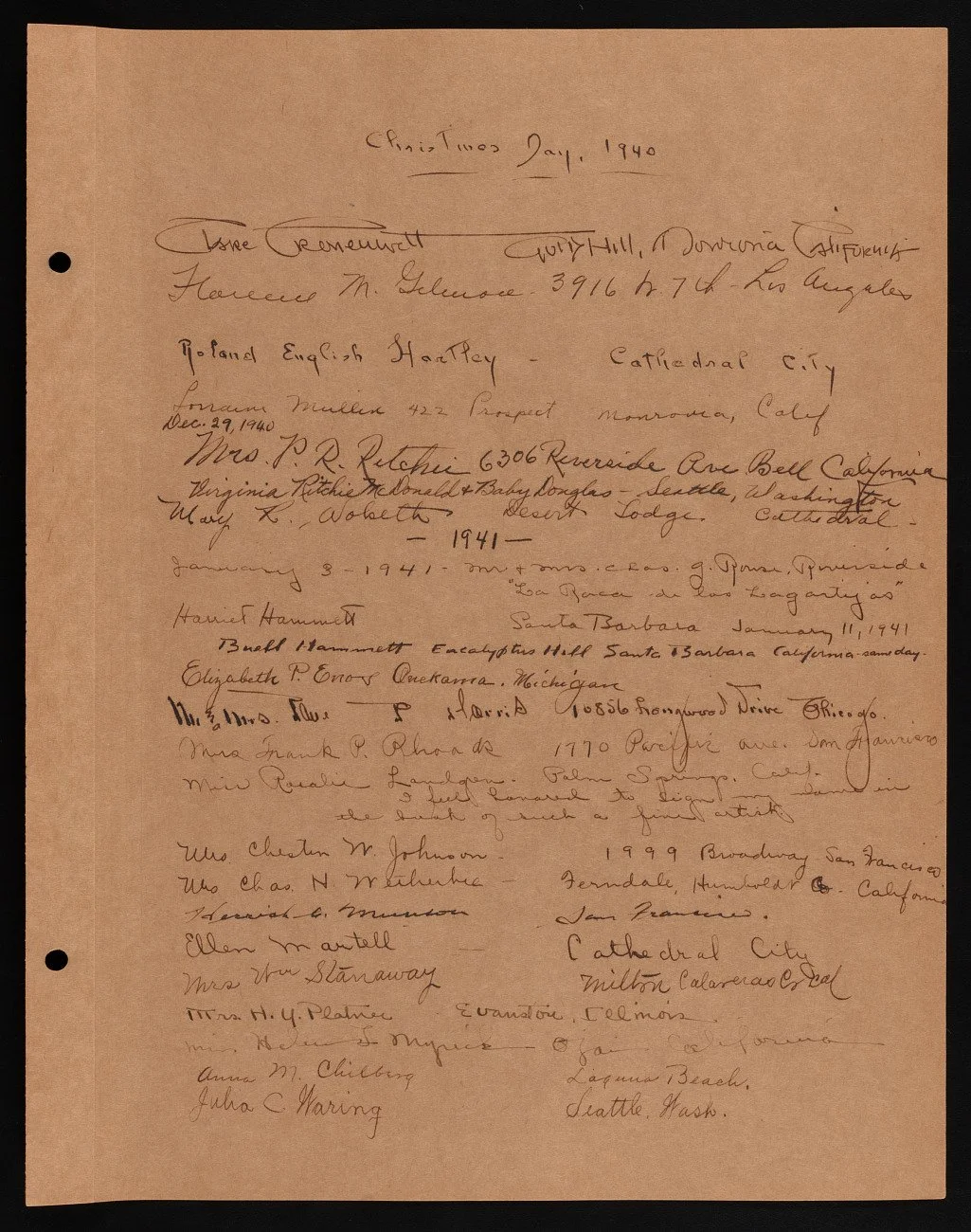
Christmas card to Raymond and Vera Jonson from Dane Rudhyar, 1935. Courtesy of the University of New Mexico Art Museum.
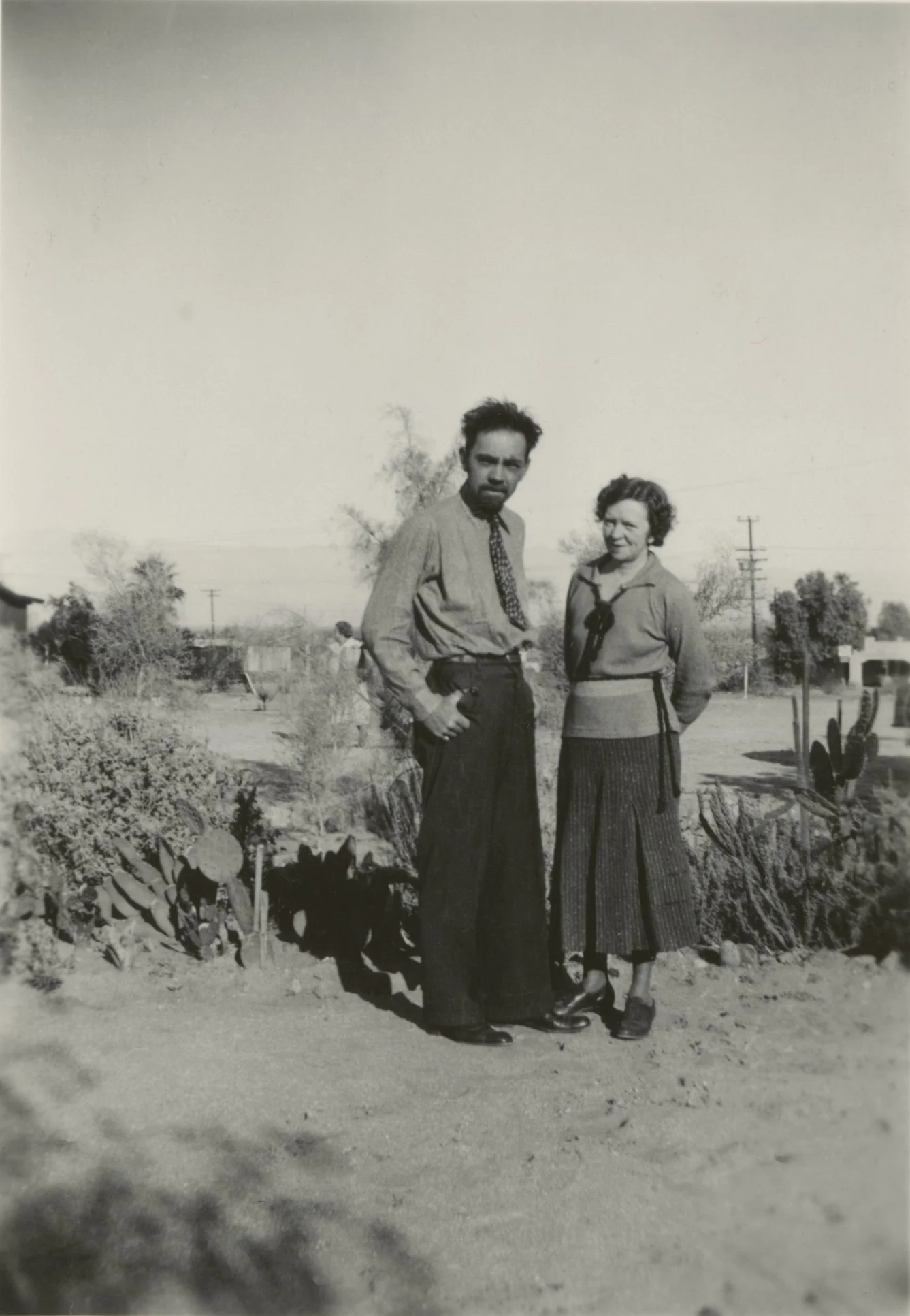
Raymond and Vera Jonson visiting Agnes Pelton’s home, Cathedral City, California, Christmas 1935. Courtesy of the University of New Mexico Art Museum.
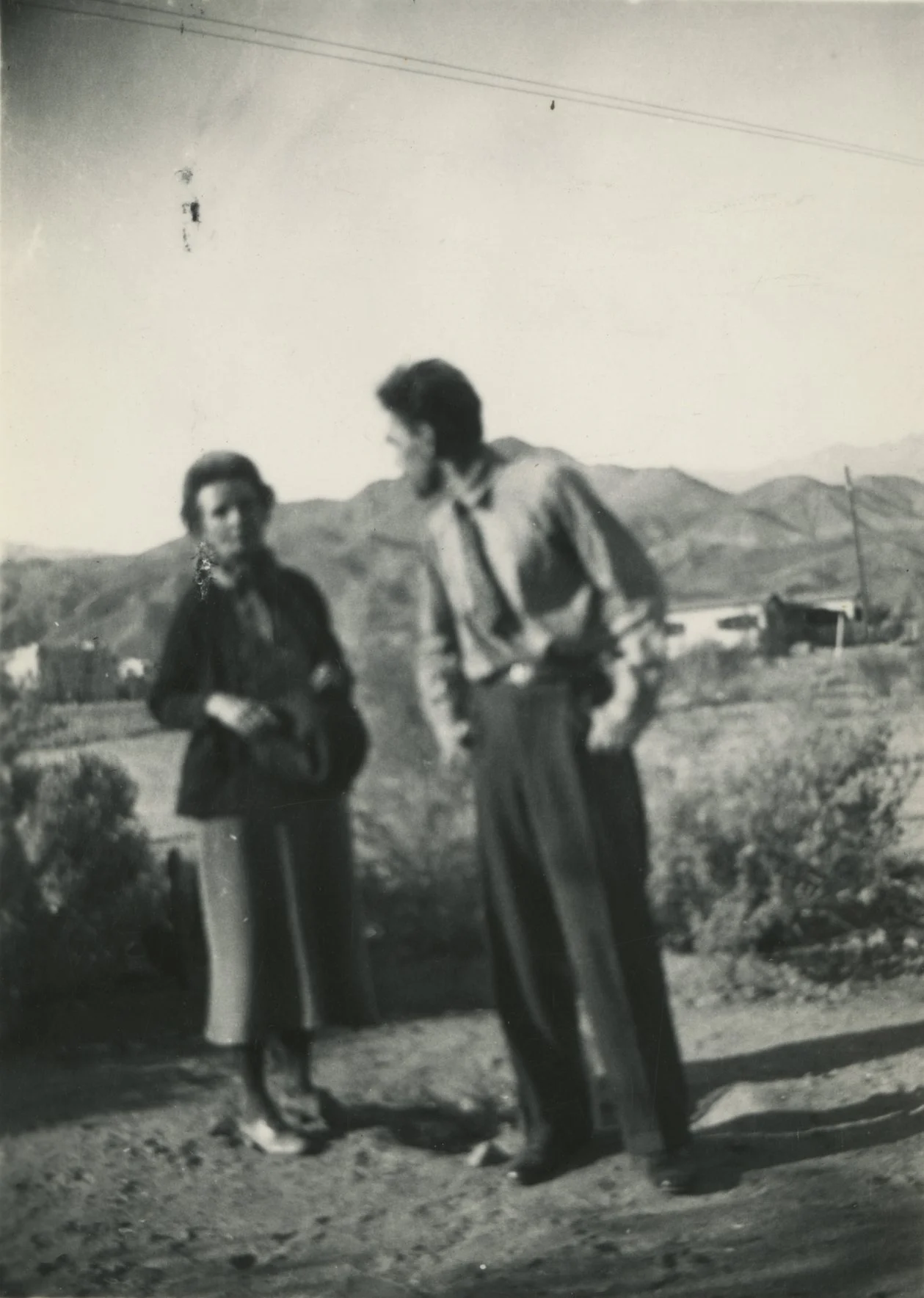
Agnes Pelton and Raymond Jonson, 1935. Courtesy of the University of New Mexico Art Museum.
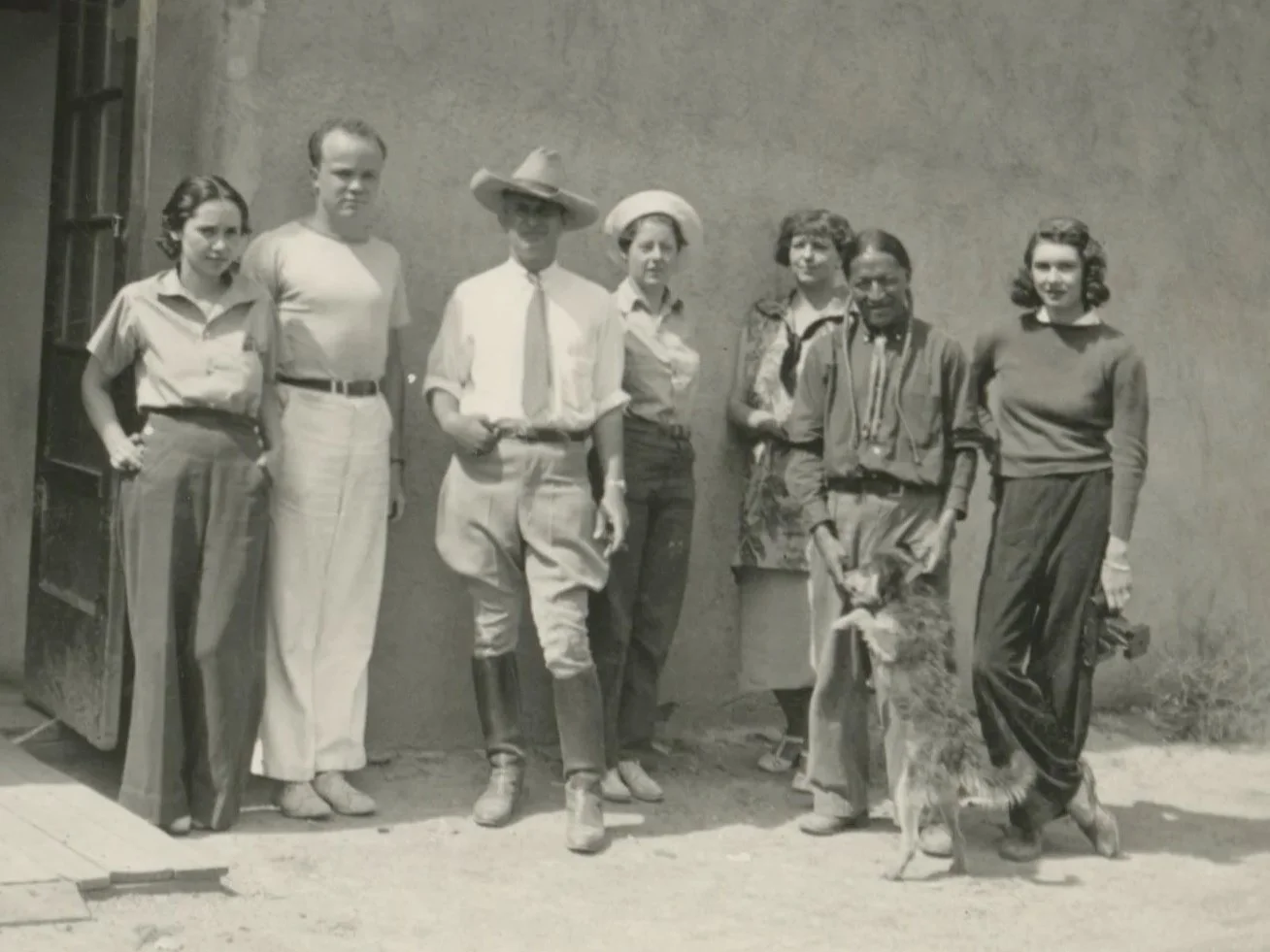
From left to right: “Polly; Horace Towner Pierce; Emil Bisttram; Eleanor; ?; Model; Florence Miller Pierce, 1936, Taos. Courtesy of the University of New Mexico Art Museum.
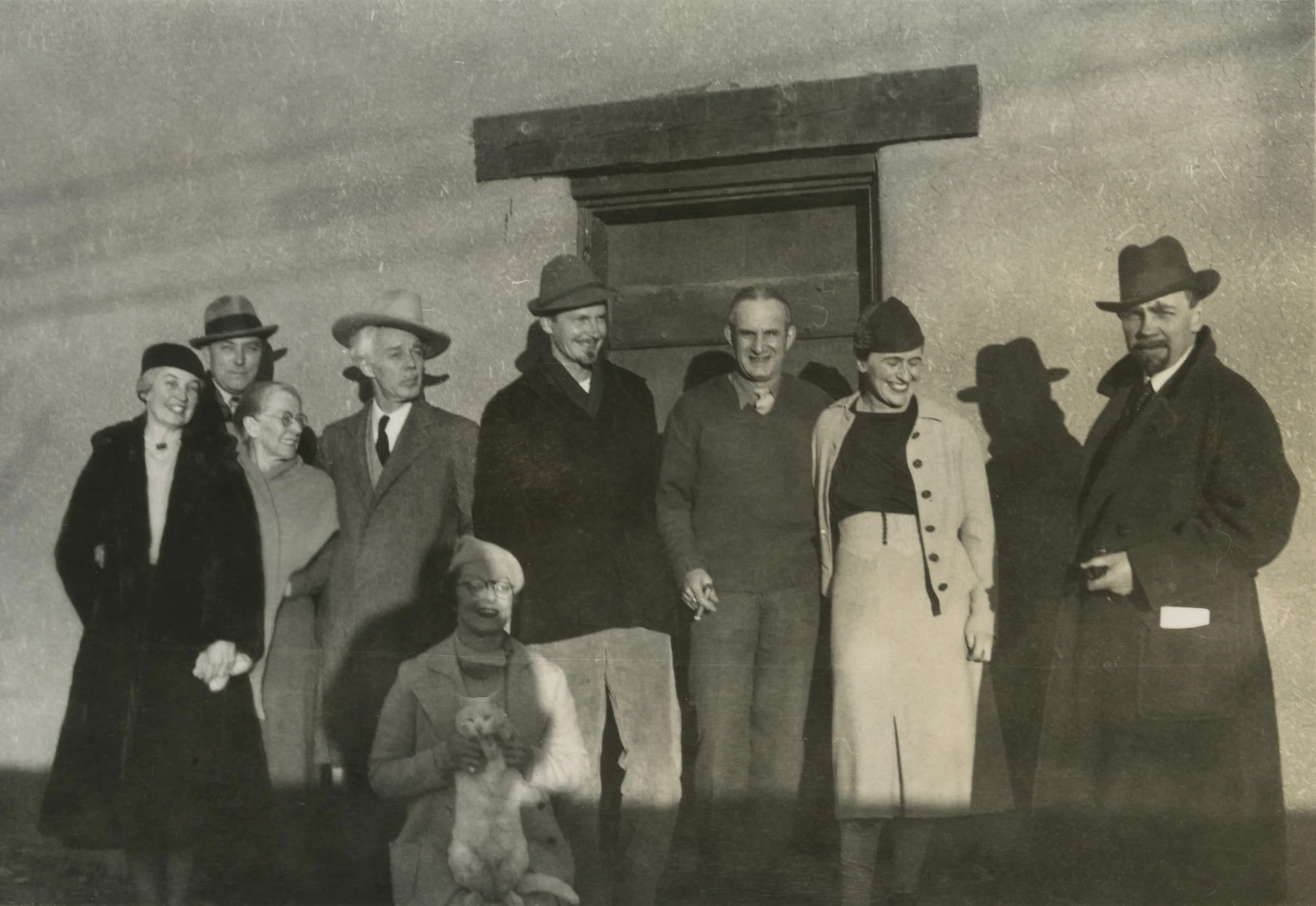
From left to right: Bess Harris; RS Hewton; Mayrion’s mother; Lawren Harris; Mayrion Bisttram; Robert Gribbroek; Emil Bisttram; Isabel McLaughlin; Raymond Jonson, Taos, NM, November 1938. Courtesy of the University of New Mexico Art Museum.
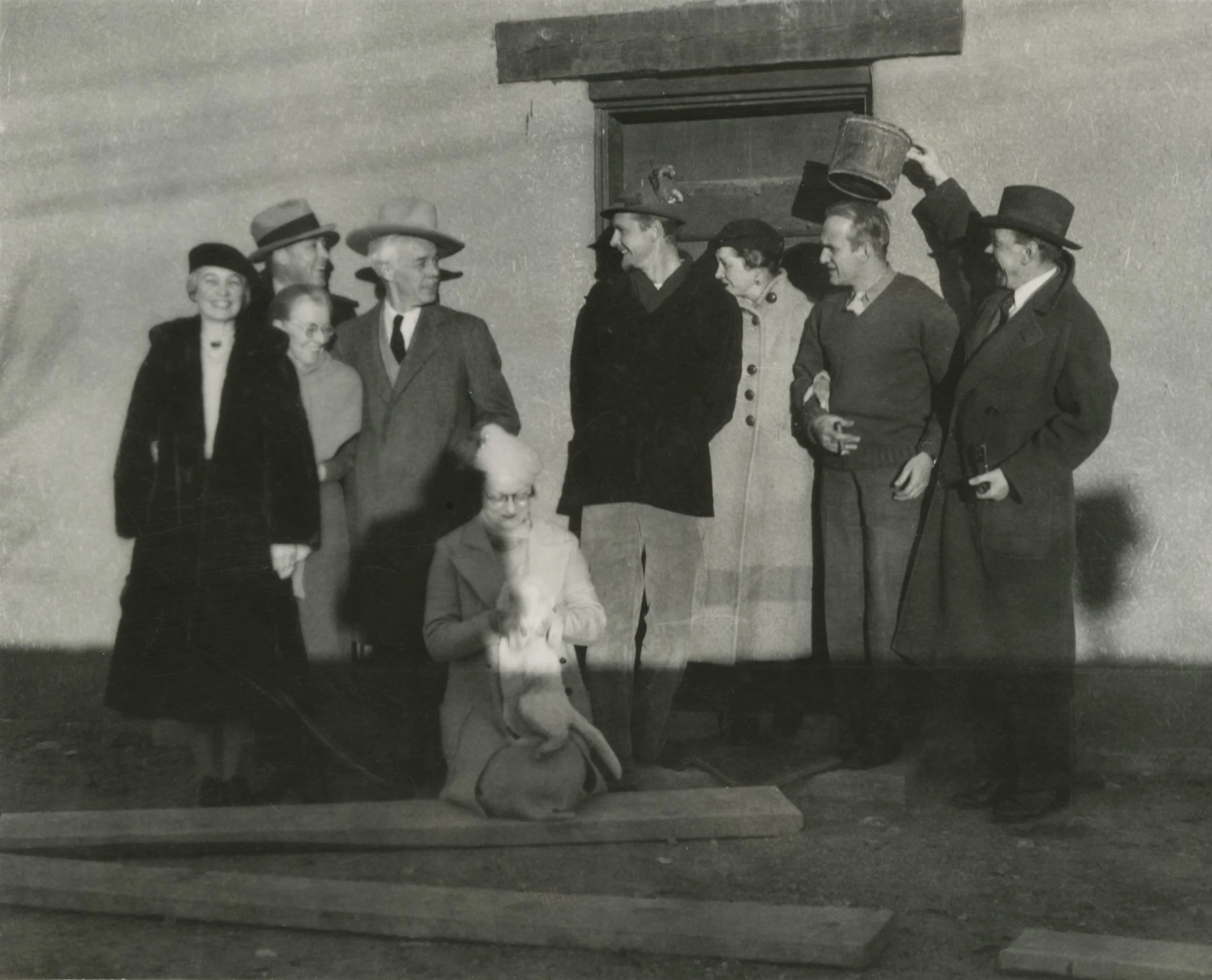
From left to right: Bess Harris; RS Hewton; Mayrion’s mother; Lawren Harris; Mayrion Bisttram; Robert Gribbroek; Benny Hewton; Emil Bisttram; Raymond Jonson, Taos, NM, November 1938. Courtesy of the University of New Mexico Art Museum.
"to carry painting beyond the appearance of the physical world, through new concepts of space, color, light and design, to imaginative realms that are idealistic and spiritual."
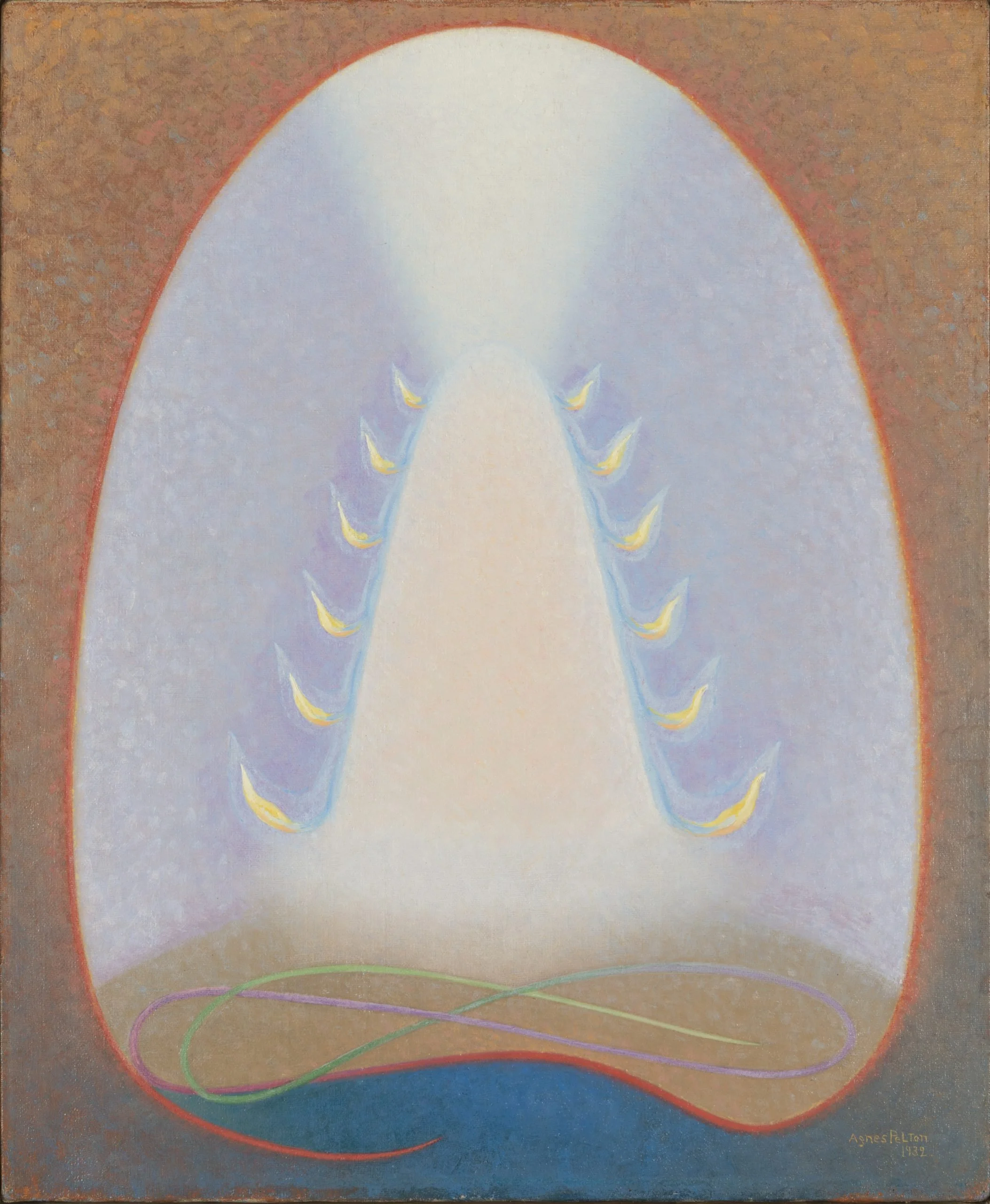
Agnes Pelton — Mount of Flame - 1932. Courtesy of the University of New Mexico Art Museum.
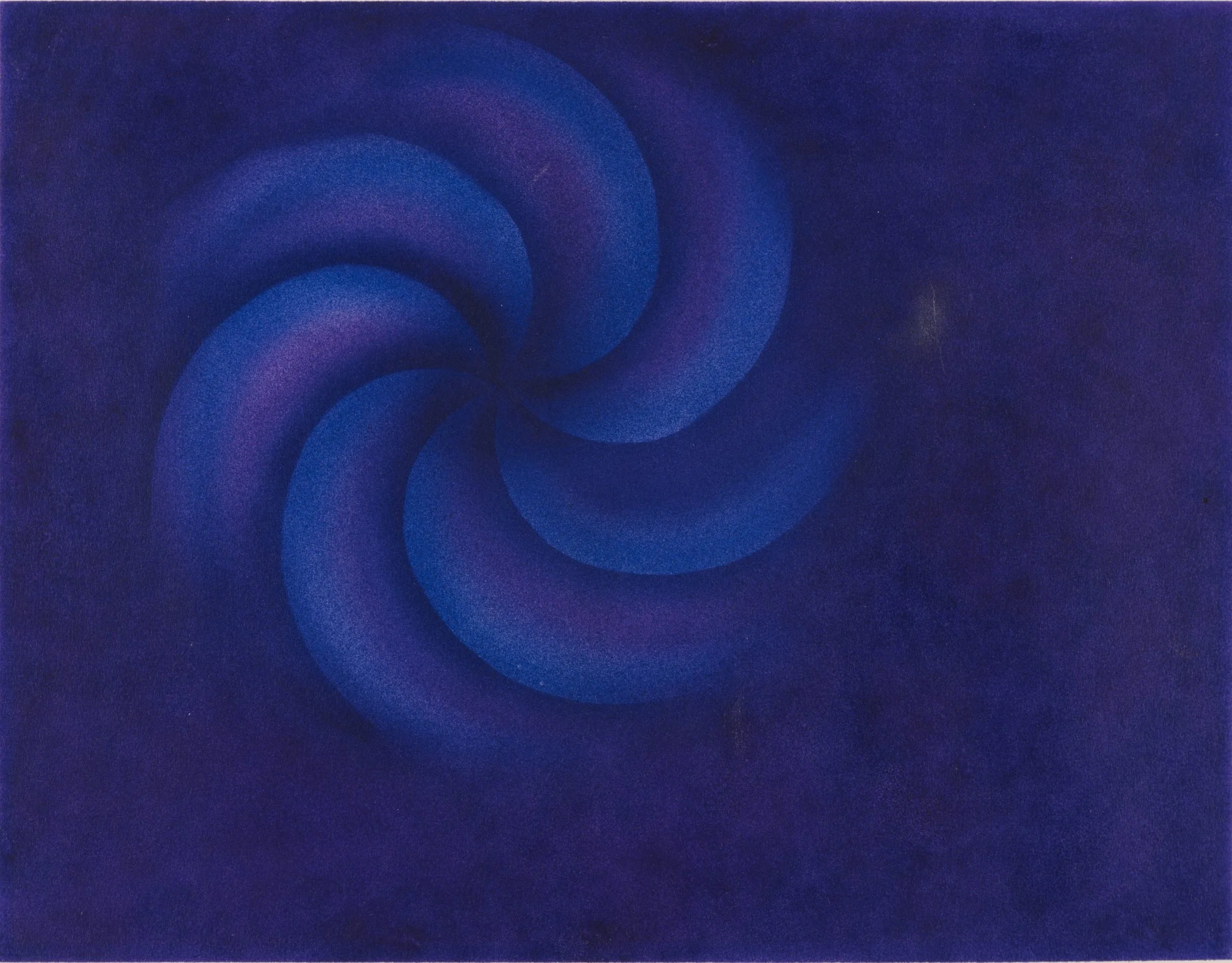
Horace Towner Pierce — Frame 2, First Movement, (Birth) from The Spiral Symphony, 1938. Courtesy of the University of New Mexico Art Museum.
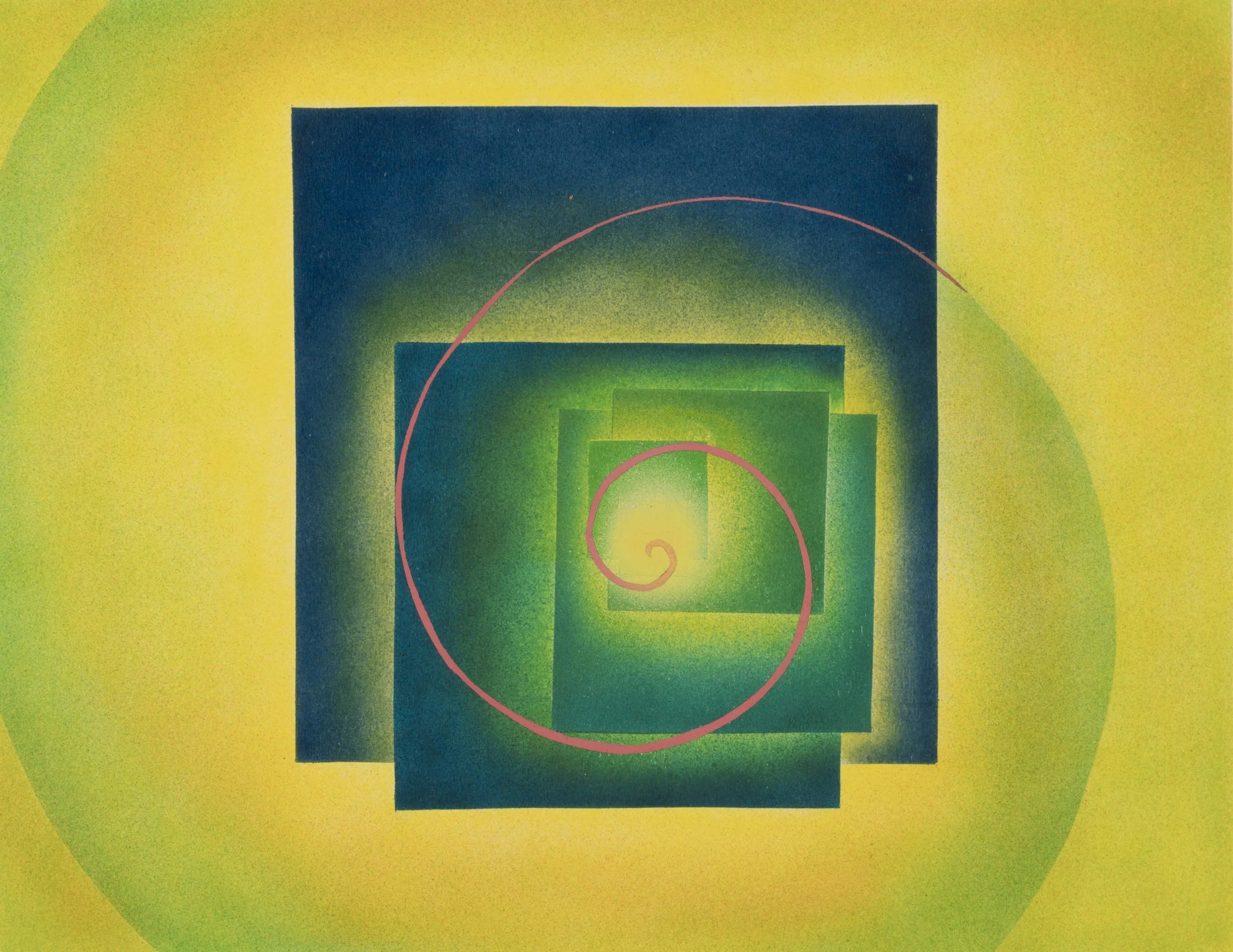
Horace Towner Pierce — Frame 12, Second Movement, (the Crystal) from The Spiral Symphony, 1938. Courtesy of the University of New Mexico Art Museum.
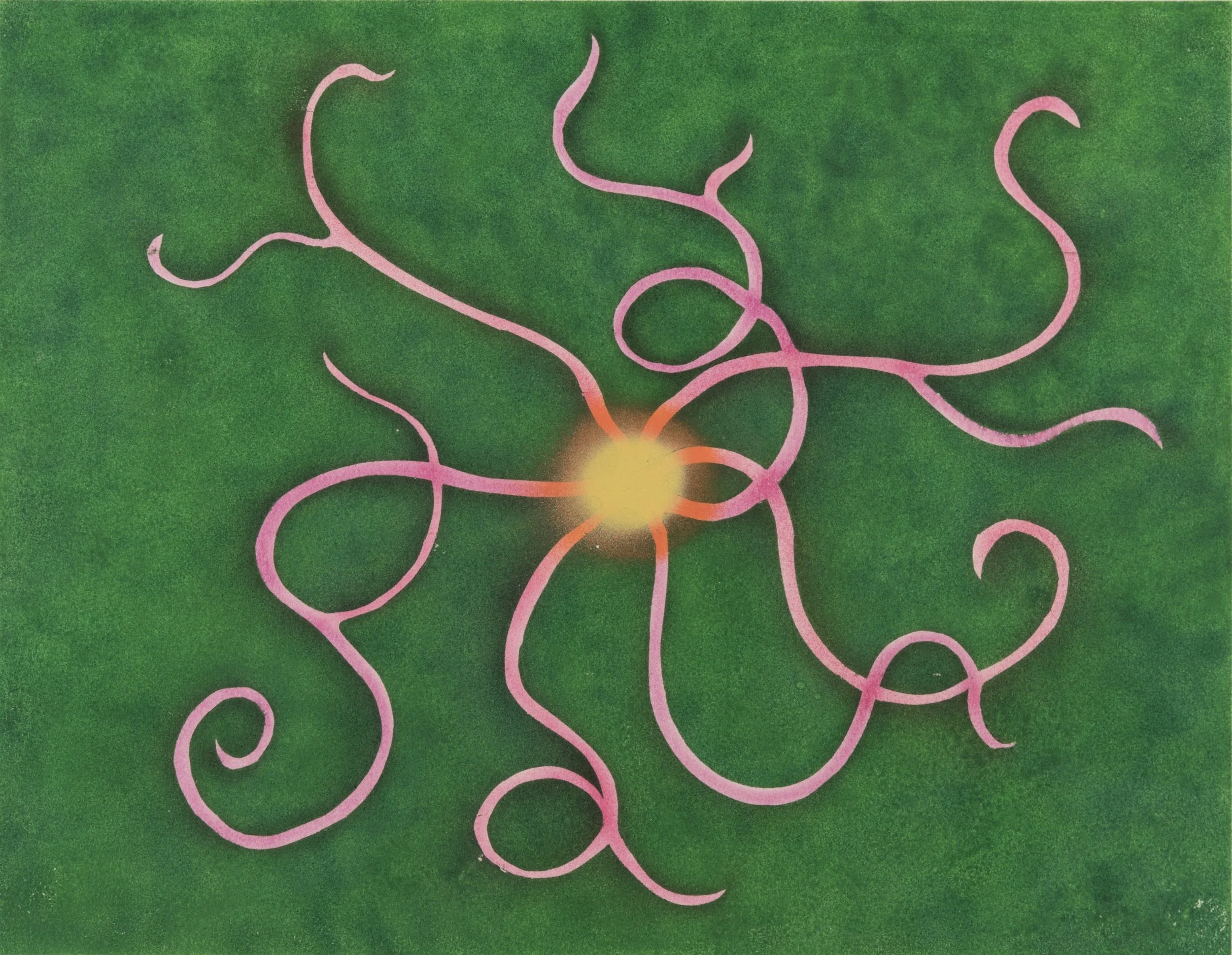
Horace Towner Pierce — Frame 19, Second Movement (The Flower) from The Spider Symphony, 1938. Courtesy of the University of New Mexico Art Museum.
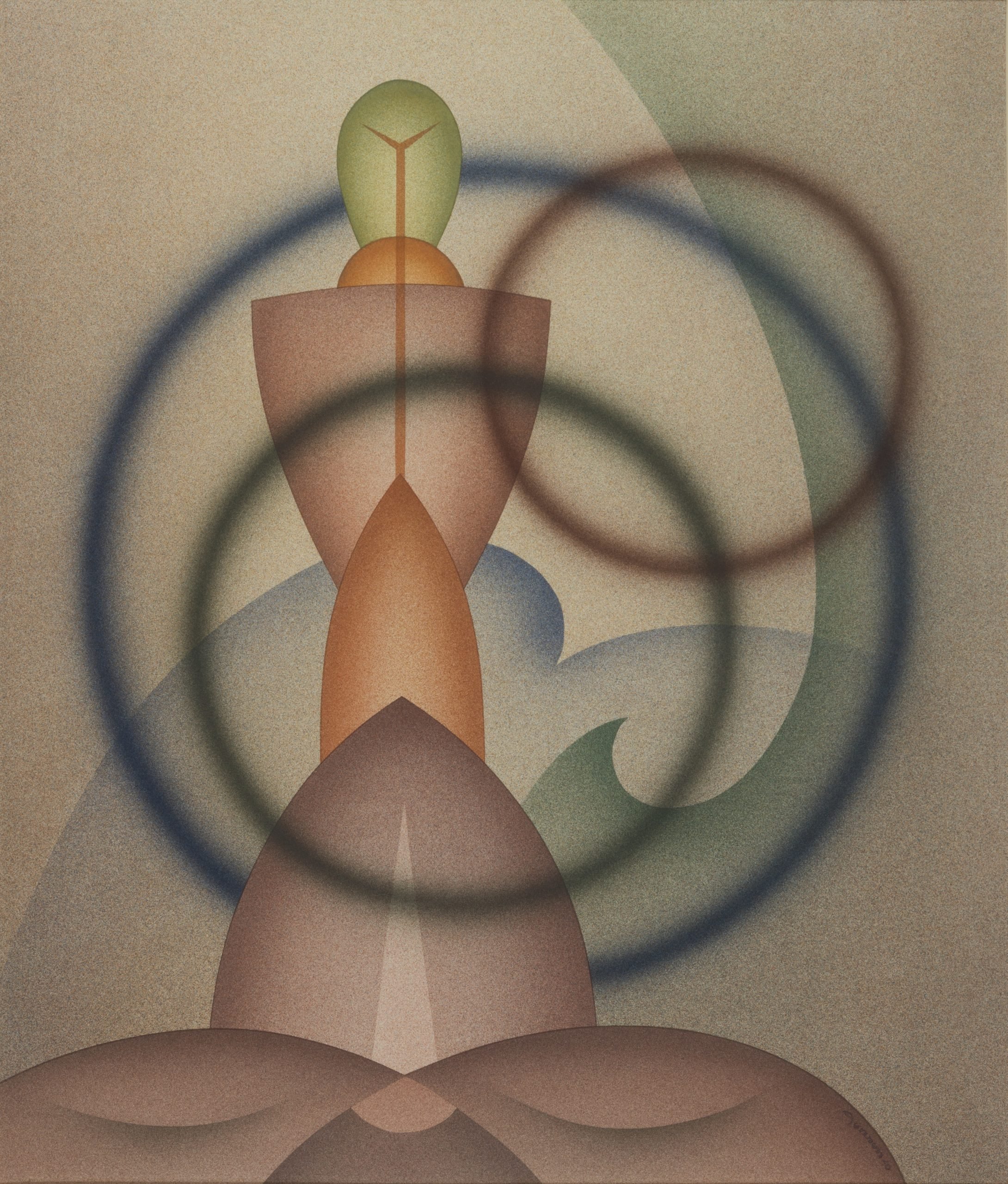
Raymond Jonson — Esoteric Trilogy - 3rd State - 1940. Courtesy of the University of New Mexico Art Museum. Courtesy of the University of New Mexico Art Museum.
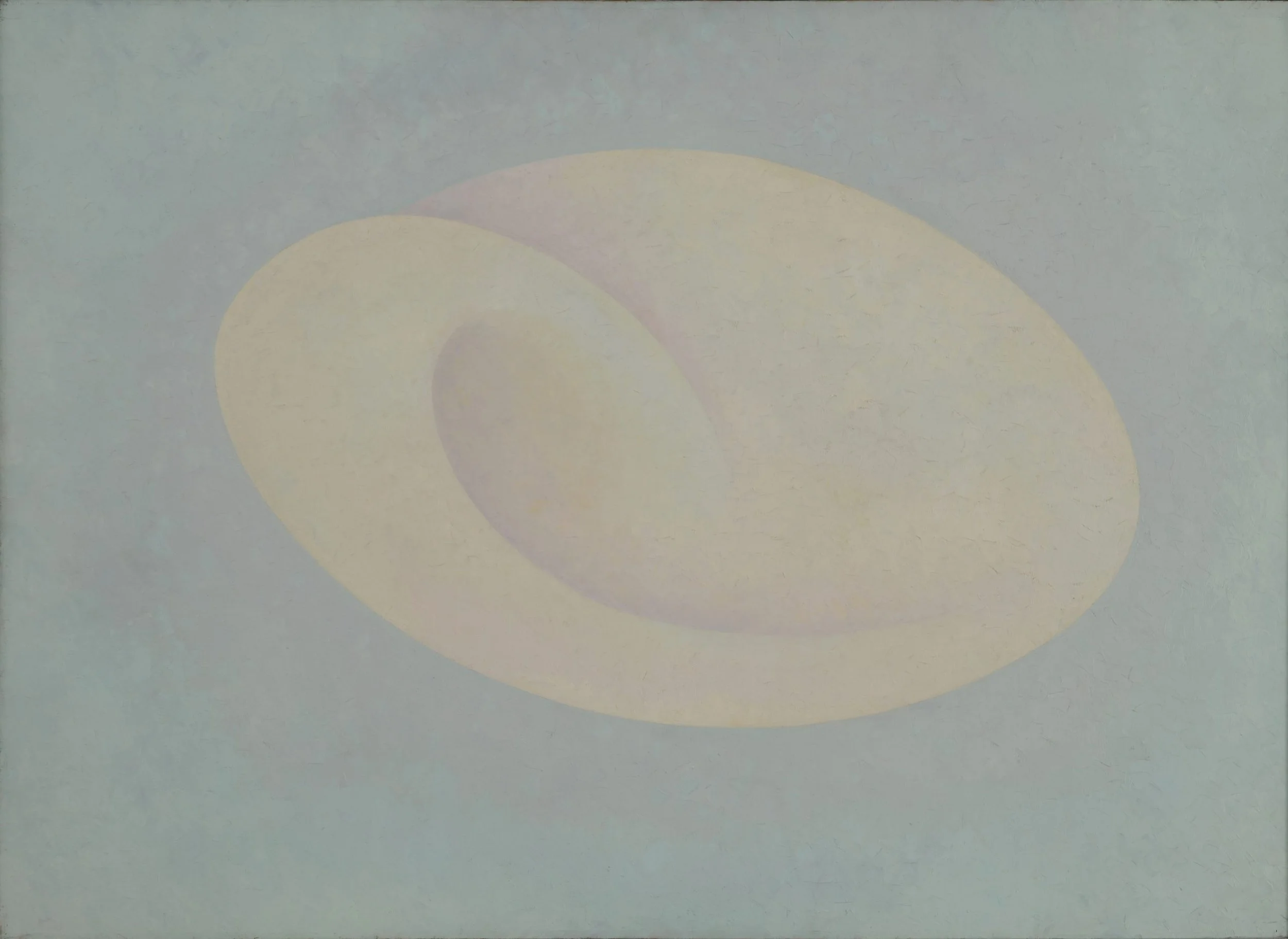
Florence Miller Pierce — First Form #1, 1944. Courtesy of the University of New Mexico Art Museum.
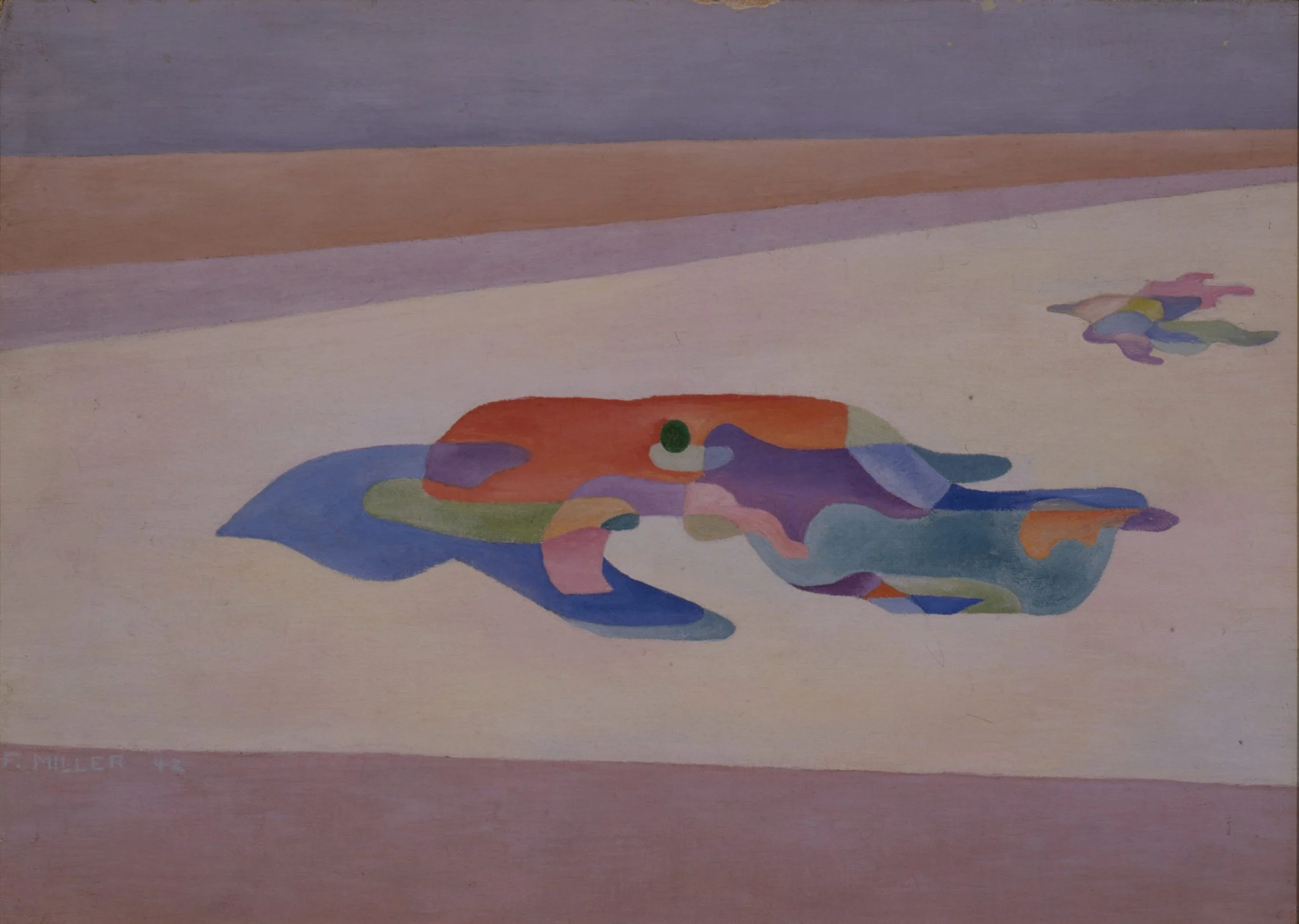
Florence Miller Pierce — Untitled (Descent) 1942. Courtesy of the University of New Mexico Art Museum.
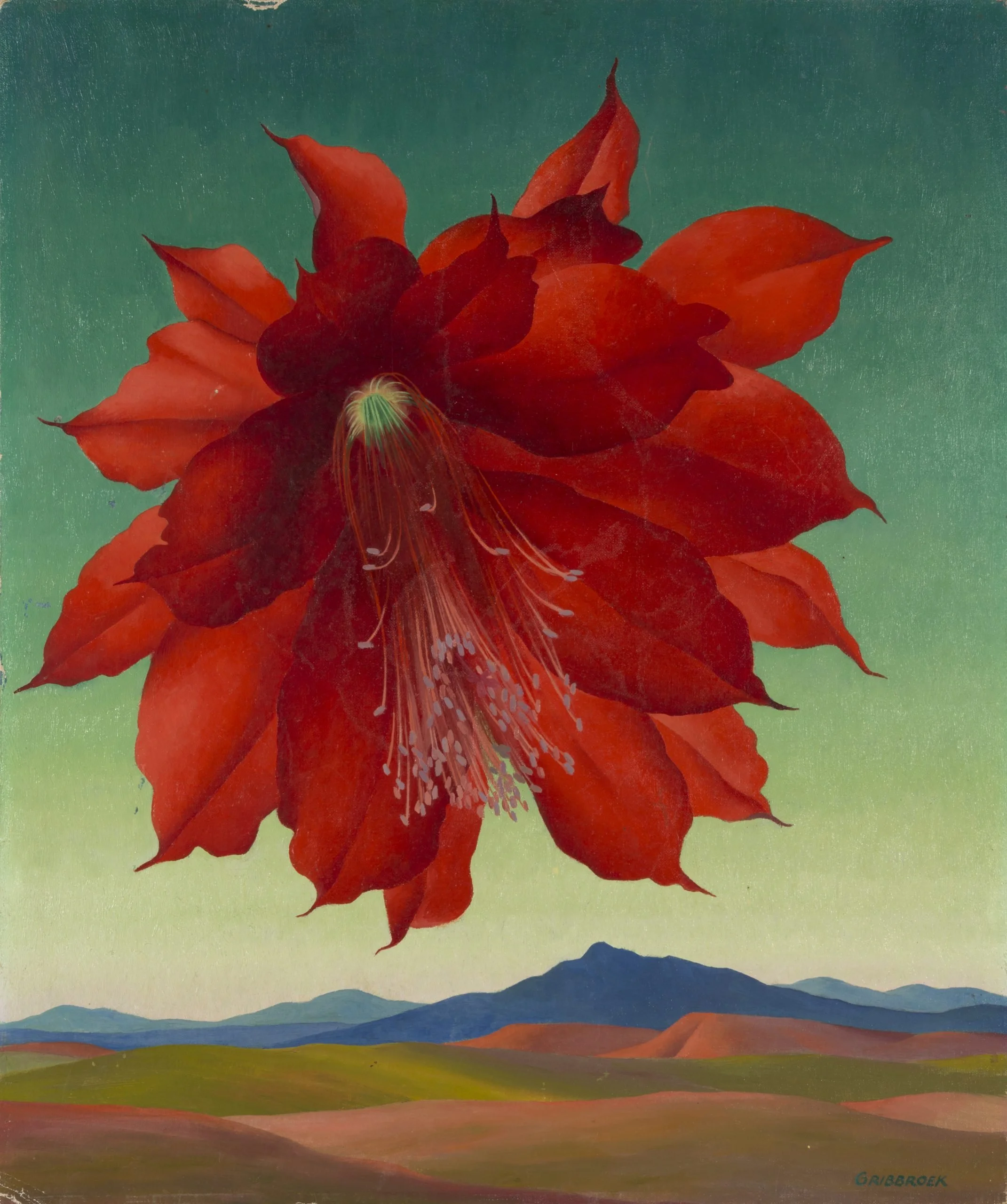
Robert Gribbroek — Epiphyllum, 1953. Courtesy of the University of New Mexico Art Museum.
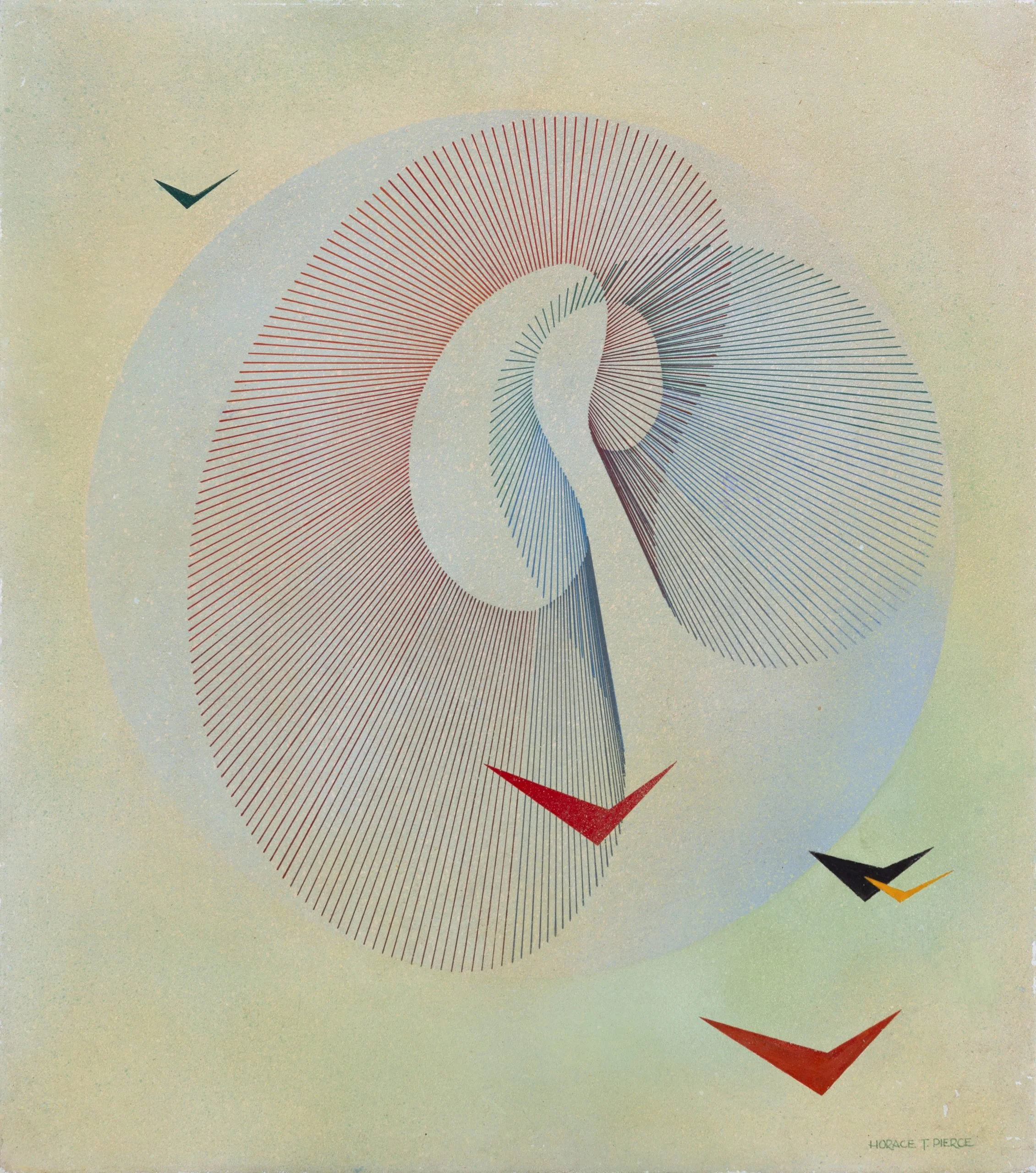
Horace Towner Pierce — Untitled, c. 1940-1955. Courtesy of the University of New Mexico Art Museum.
END OF LIFE
“A Beauty Not for the Eye Alone”
Agnes Pelton’s Enduring Vision
In the final years of her life, Pelton’s work began to receive wider recognition, both within the Transcendental Painting Group and beyond it. Yet she remained devoted to the quiet focus and inward attention that had shaped her practice for decades. Living and working in the desert, she continued to paint as a form of inquiry and inner alignment. By the 1950s, Pelton’s health was failing, and on March 13, 1961, she passed away from liver cancer. Leaving no immediate heirs, her belongings were distributed to her cousins.
In a letter written on July 28, 1961 to Pelton’s cousin Laura Gardin Fraser, Pelton’s friend and caretaker Gerry Goodall recounts:
“I get sick every time I think of the abstraction Agnes gave to the Santa Barbara Gallery, worth many hundred dollars, and because the curator didn’t understand or like abstractions, put it in the White Elephant Sale for $40.00. Alice Kennedy saw it, and while she was out cashing a check to buy it, the price had been reduced to $15.00.”
Her paintings were relatively unknown during her lifetime and in the decades thereafter. Pelton’s slow reemergence within the margins of American art began through critical and academic reevaluations of her place in art history. In the 1980s, archival efforts aimed at establishing a baseline of primary research materials began to take shape. The Agnes Pelton papers at the Smithsonian Institution were assembled by Cornelia and Irving Sussman for a biography of Agnes Pelton. They were donated to the Archives of American Art by gallery director Jan Rindfleisch on behalf of the Sussmans in 1984.
The majority of her works were cataloged in a publication for an exhibition curated by the art historian Margaret Stainer in 1989, which was followed by the exhibition curated by Michael Zakian at the Palm Springs Museum in 1995.
Pelton once articulated her aim to seek, through painting, “a beauty not for the eye alone, but of a more comprehensive nature, carrying a more direct impact on our newly developing perception….”
Nearly a century later, her work continues to speak across time. Her paintings remain quietly transformative, inviting reflection rather than declaration, and affirming her place within the evolving history of American modernism.
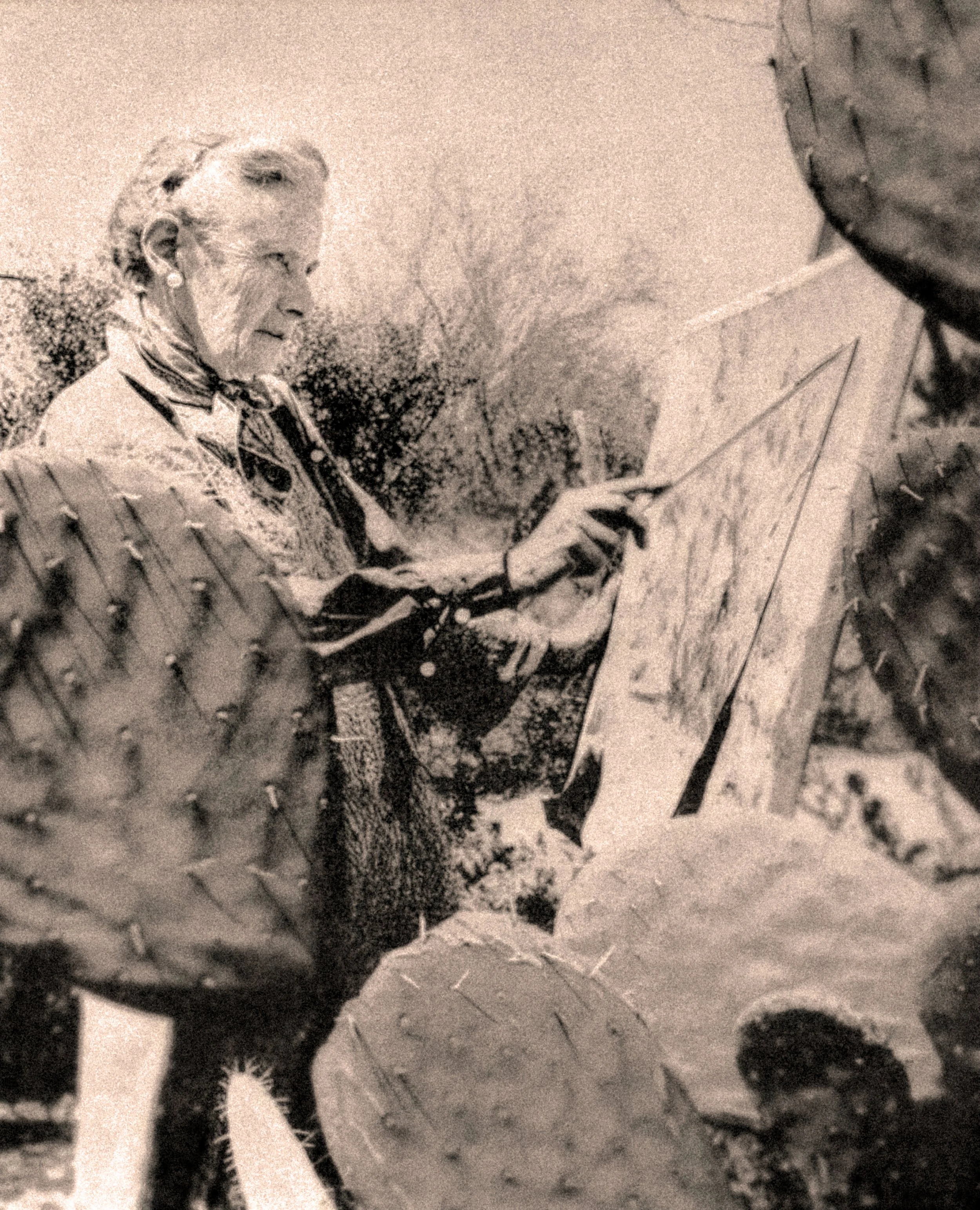
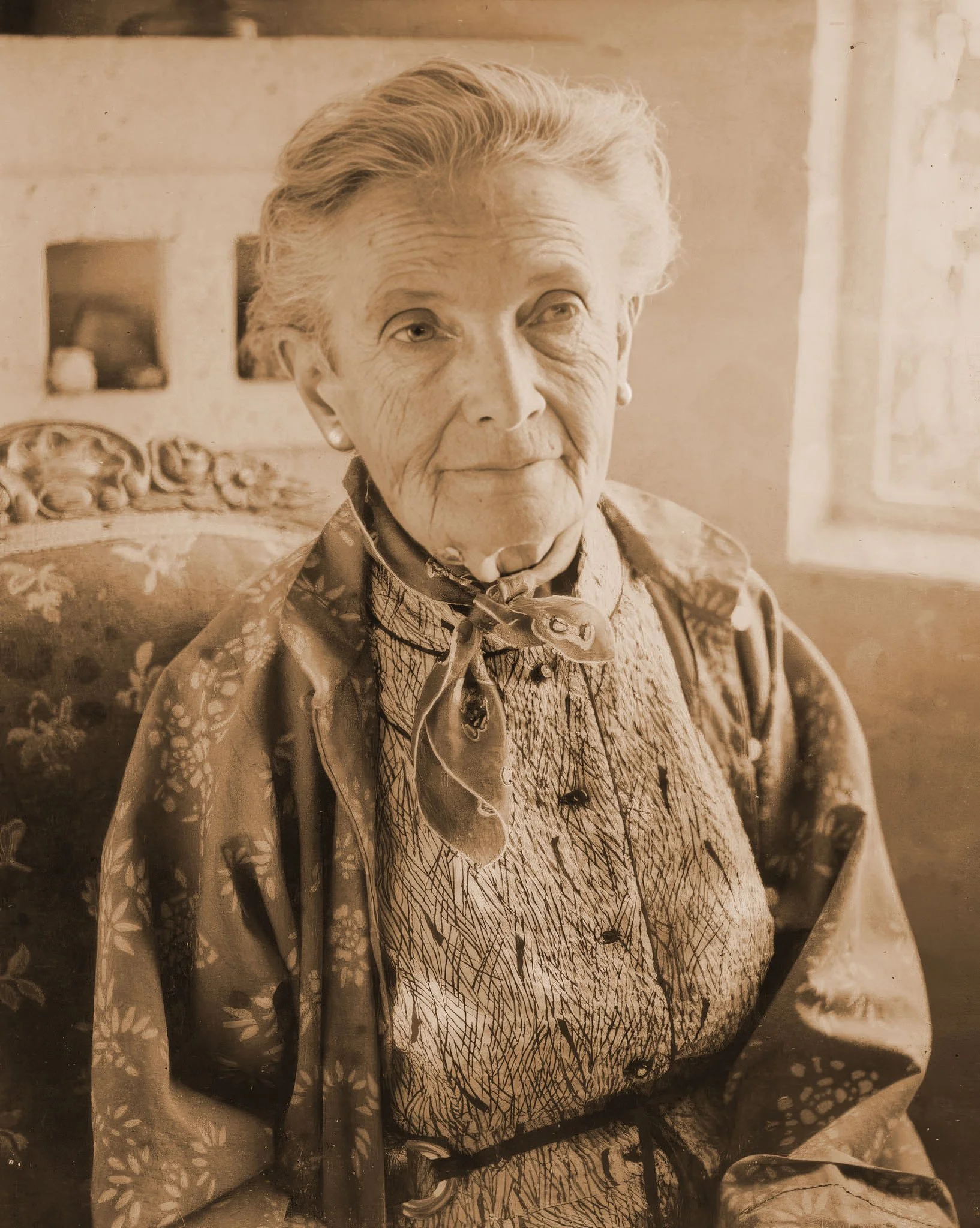
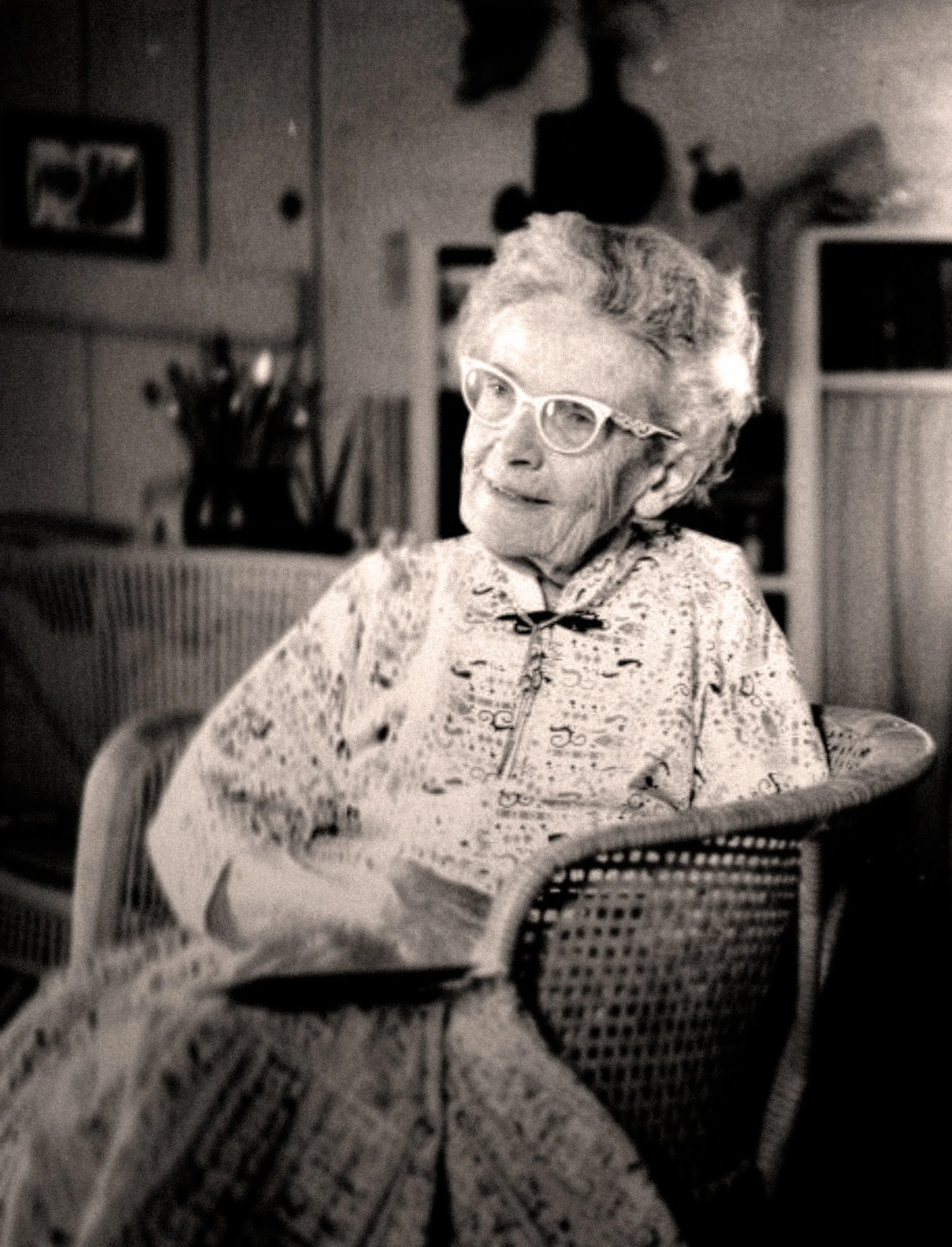
Agnes spent her final years in Cathedral City, where she died just before turning eighty. She was cremated, and her ashes were laid to rest in the San Jacinto Mountains. In this way, she returned to the landscape and mountains she loved, a place where she found a deep sense of beauty and an enduring connection to the spirit of the natural world.
⬥
Agnes Pelton
1881–1961
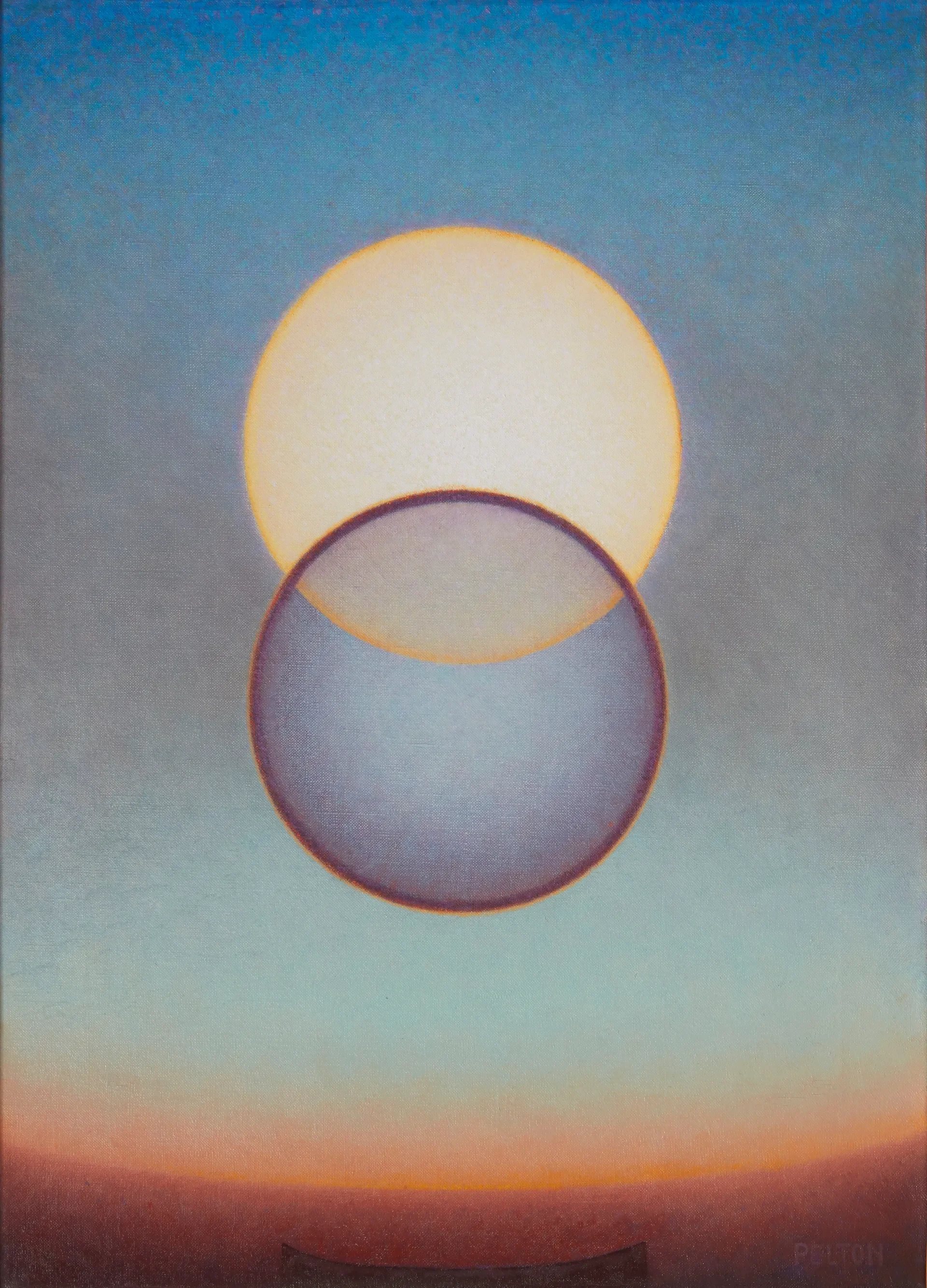
Agnes Pelton, Departure, 1952. Photograph by Peter Palladino, courtesy of the Agnes Pelton Society.
⬥
“These pictures are conceptions of light – the essence of fire, not as we see it in the material world but as the radiance of the inner being.”
— Agnes Pelton
A Lasting Presence
-
Agnes Pelton: Desert Transcendentalist (2020)
Presented at the Whitney Museum of American Art, this exhibition situated Pelton’s work within American modernism, emphasizing spiritual abstraction and the formative influence of the desert landscape on her visual language. -
Agnes Pelton: Desert Transcendentalist (2020–2021) Shown near Pelton’s longtime home, the exhibition foregrounded the connection between her mature work and the desert environment, with particular attention to light, place, and inward reflection.
-
Agnes Pelton: Desert Transcendentalist (2019–2020)
This presentation examined Pelton’s engagement with transcendentalism and non-objective painting, highlighting the consistency of her vision and its relationship to artistic and spiritual currents in the American Southwest. -
Special Exhibition, Agnes Pelton: Desert Transcendentalist
Agnes Pelton: Desert Transcendentalist is the first exhibition on the little-known American painter in more than 24 years. Born to American parents in Stuttgart, Germany, Agnes Pelton (1881-1961) and her family briefly lived in Basel, Switzerland before returning to the United States in 1888. -
Pelton & Jonson: The Transcendent 1930s (2023)
This exhibition placed Pelton’s work in dialogue with Raymond Jonson, examining shared commitments to abstraction and metaphysical inquiry within the Transcendental Painting Group. -
Another World: The Transcendental Painting Group, 1938–1945
In 1938 in New Mexico, a loose configuration of artists came together to form the Transcendental Painting Group. Led by New Mexico painters Raymond Jonson and Emil Bisttram, and joined by painters such as Agnes Pelton and Lawren Harris, the members of the group sought to explore spiritually heightened abstraction by employing free-wheeling symbols and imagery drawn from the collective unconscious. According to their manifesto they strove "to carry painting beyond the appearance of the physical world, through new concepts of space, color, light and design to imaginative realms that are idealistic and spiritual.” Due to the onset of World War II the group was short-lived. However, their paintings continue to emphasize how abstraction can be used in service of the spiritual. Another World is the first comprehensive traveling museum exhibition devoted to the group. -
A critical retrospective that toured nationally, originating at the Palm Springs Desert Museum (now the Palm Springs Art Museum). This show is credited with first bringing her out of relative obscurity.
AI-generated reenactment of Agnes Pelton in later life, 1957. Based on an original photograph from the Carolyn Tilton Cunningham Family Collection. Courtesy of Nyna Dolby.